Visual Tools
Calculators
Tables
Mathematical Keyboard
Converters
Other Tools


Solvability of Linear Systems


When Solutions Exist and When They Are Unique

Two separate questions govern every linear system: does at least one solution exist, and if so, is that solution the only one? The rank of the coefficient matrix answers both. A single integer determines whether the system is inconsistent, uniquely solvable, or infinitely underdetermined — and characterizes the geometry of the solution set in each case.


The Two Questions

Given the system Ax=bA\mathbf{x} = \mathbf{b} with AA of size m×nm \times n, two logically independent questions arise.

Existence: is there at least one vector x\mathbf{x} satisfying Ax=bA\mathbf{x} = \mathbf{b}? This asks whether b\mathbf{b} lies in the column space of AA.

Uniqueness: if a solution exists, is it the only one? This asks whether the null space of AA is trivial.

The two questions are independent — existence can hold without uniqueness, and non-existence makes uniqueness moot. Both are answered by the rank of AA.

The Existence Condition

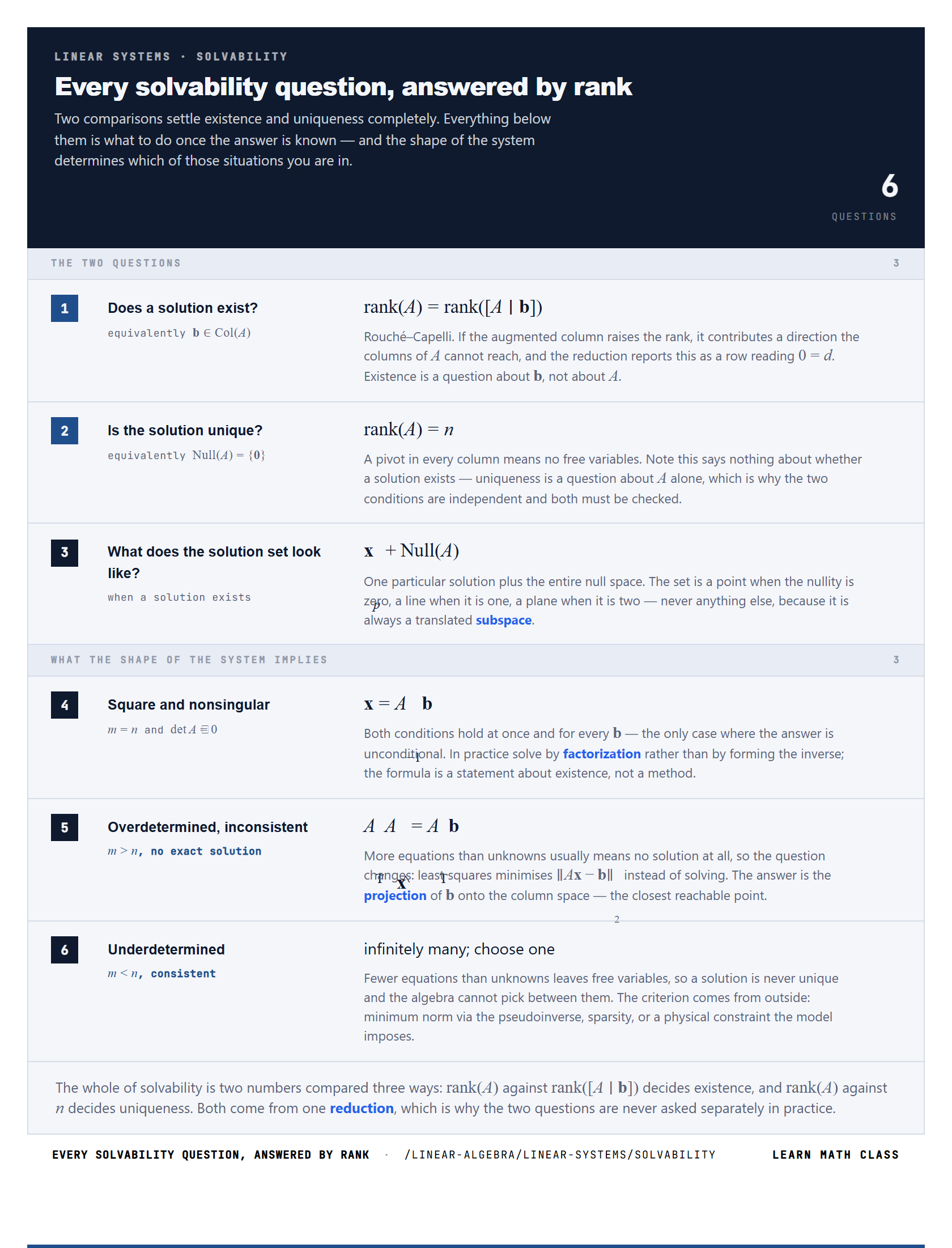
The system Ax=bA\mathbf{x} = \mathbf{b} has at least one solution if and only if

rank(A)=rank([Ab])\text{rank}(A) = \text{rank}([A \mid \mathbf{b}])


When this condition holds, b\mathbf{b} is already a linear combination of the columns of AA, so appending b\mathbf{b} as an extra column does not introduce a new independent direction — the rank stays the same.

When the condition fails — rank([Ab])>rank(A)\text{rank}([A \mid \mathbf{b}]) > \text{rank}(A) — the vector b\mathbf{b} is not in the column space. In the echelon form of the augmented matrix, this appears as a row [0  0    0d][0 \; 0 \; \cdots \; 0 \mid d] with d0d \neq 0: the equation 0=d0 = d has no solution, and the system is inconsistent.

Since appending one column can increase the rank by at most 11, the only possibilities are rank([Ab])=rank(A)\text{rank}([A \mid \mathbf{b}]) = \text{rank}(A) (consistent) or rank([Ab])=rank(A)+1\text{rank}([A \mid \mathbf{b}]) = \text{rank}(A) + 1 (inconsistent).

The Uniqueness Condition

When a solution exists, it is unique if and only if

rank(A)=n\text{rank}(A) = n


where nn is the number of unknowns. Full column rank means every column of AA contains a pivot, leaving no free variables. The null space is {0}\{\mathbf{0}\}, so the particular solution xp\mathbf{x}_p stands alone with nothing to add.

When rank(A)<n\text{rank}(A) < n, there are nrank(A)n - \text{rank}(A) free variables. Each free variable parametrizes a direction along which the solution can move without violating the equations. The solution set is infinite — a translated copy of the null space, which has dimension nrank(A)n - \text{rank}(A).

The Three Cases Combined

Putting existence and uniqueness together, every linear system falls into exactly one of three cases.

rank(A)<rank([Ab])\text{rank}(A) < \text{rank}([A \mid \mathbf{b}]): no solution. The system is inconsistent.

rank(A)=rank([Ab])=n\text{rank}(A) = \text{rank}([A \mid \mathbf{b}]) = n: exactly one solution. The system is consistent and fully determined.

rank(A)=rank([Ab])<n\text{rank}(A) = \text{rank}([A \mid \mathbf{b}]) < n: infinitely many solutions. The system is consistent but underdetermined, with nrank(A)n - \text{rank}(A) free parameters.

There is no case with a finite number of solutions greater than one. If two distinct solutions exist, their difference lies in the null space, which is a subspace — and a nontrivial subspace contains infinitely many vectors, generating infinitely many solutions.

The Rouché–Capelli Theorem

The existence condition rank(A)=rank([Ab])\text{rank}(A) = \text{rank}([A \mid \mathbf{b}]) is known as the Rouché–Capelli theorem (or the Kronecker–Capelli theorem in some traditions). It states:

The system Ax=bA\mathbf{x} = \mathbf{b} is consistent if and only if the coefficient matrix and the augmented matrix have the same rank. When consistent, the solution set has dimension nrank(A)n - \text{rank}(A).

The theorem unifies the existence and dimension questions into a single rank comparison. It applies to every linear system regardless of the shape of AA — square, tall, or wide. The proof follows directly from the column-space interpretation: bCol(A)\mathbf{b} \in \text{Col}(A) if and only if adding b\mathbf{b} as a column does not increase the rank.

Square Systems

When AA is n×nn \times n, the determinant provides the sharpest diagnostic.

If det(A)0\det(A) \neq 0: the matrix is invertible, the rank is nn, and the system Ax=bA\mathbf{x} = \mathbf{b} has exactly one solution for every b\mathbf{b}. The solution is x=A1b\mathbf{x} = A^{-1}\mathbf{b}, or equivalently, the solution obtained by Gaussian elimination. Existence and uniqueness both hold universally — the right-hand side does not matter.

If det(A)=0\det(A) = 0: the matrix is singular, the rank is less than nn, and the outcome depends on b\mathbf{b}. For some b\mathbf{b} (those in the column space), infinitely many solutions exist. For other b\mathbf{b} (those outside the column space), no solution exists. The determinant test determines whether the coefficient matrix is adequate; the rank comparison with the augmented matrix determines whether the specific b\mathbf{b} is reachable.

Overdetermined Systems

When m>nm > n — more equations than unknowns — the system is overdetermined. The coefficient matrix is tall, and generically, no solution exists.

The column space of AA is at most nn-dimensional inside Rm\mathbb{R}^m. When m>nm > n, this column space is a proper subspace — most vectors in Rm\mathbb{R}^m lie outside it. A randomly chosen b\mathbf{b} will almost certainly not be in the column space, making the system inconsistent.

A solution exists only when b\mathbf{b} happens to lie in the column space — when the extra equations are consistent with the first nn. When a solution does exist and rank(A)=n\text{rank}(A) = n, it is unique.

When no exact solution exists, the least-squares approach finds the x^\hat{\mathbf{x}} that minimizes Axb2\|A\mathbf{x} - \mathbf{b}\|^2 — the closest approximation. The least-squares solution satisfies the normal equations ATAx^=ATbA^T A \hat{\mathbf{x}} = A^T \mathbf{b} and is the projection of b\mathbf{b} onto the column space.

Underdetermined Systems

When m<nm < n — fewer equations than unknowns — the system is underdetermined. If a solution exists, it is never unique: the rank cannot exceed mm, which is less than nn, so at least nmn - m free variables remain.

The solution set, when nonempty, is an affine subspace of dimension at least nmn - m. Multiple vectors x\mathbf{x} satisfy the equations, and additional criteria beyond the linear system itself are needed to select a preferred one.

Common selection criteria include minimum norm (the x\mathbf{x} closest to 0\mathbf{0}, given by the pseudoinverse x=AT(AAT)1b\mathbf{x} = A^T(AA^T)^{-1}\mathbf{b}), sparsity (the x\mathbf{x} with the fewest nonzero entries, central to compressed sensing), and physical constraints (bounds or nonnegativity in engineering applications).

Underdetermined systems are not defective — they arise naturally whenever a problem has more degrees of freedom than constraints. The linear system identifies the feasible set; the selection criterion picks a point within it.

Geometric Interpretation

Each equation ai1x1+ai2x2++ainxn=bia_{i1}x_1 + a_{i2}x_2 + \cdots + a_{in}x_n = b_i defines a hyperplane in Rn\mathbb{R}^n — a flat set of dimension n1n - 1. The solution set of the full system is the intersection of all mm hyperplanes.

When the system is inconsistent, the hyperplanes have no common point. In R2\mathbb{R}^2 this means parallel lines. In R3\mathbb{R}^3 it can mean parallel planes, or planes arranged in a triangular prism where each pair intersects but no point lies on all three.

When the system has a unique solution, the hyperplanes meet at a single point. This requires at least nn independent equations — enough to cut the solution space down from nn dimensions to 00.

When the system has infinitely many solutions, the hyperplanes meet along a flat of dimension nrn - r, where r=rank(A)r = \text{rank}(A). Each independent equation reduces the dimension of the intersection by one, and the rank counts how many equations cut independently. The remaining nrn - r dimensions are the free directions in the solution set.

Structure of the Solution Set

When Ax=bA\mathbf{x} = \mathbf{b} is consistent, the complete solution set has the form

{xp+xh:xhNull(A)}\{\mathbf{x}_p + \mathbf{x}_h : \mathbf{x}_h \in \text{Null}(A)\}


where xp\mathbf{x}_p is any one particular solution. This set is a coset of the null space — the null space translated by xp\mathbf{x}_p. In geometric terms, it is an affine subspace: a subspace shifted away from the origin.

The dimension of the solution set equals the dimension of the null space: nrank(A)n - \text{rank}(A). When this is 00, the solution set is a single point {xp}\{\mathbf{x}_p\}. When it is 11, the solution set is a line. When it is 22, a plane. The shape is always a flat, and the null space determines its orientation.

The particular solution xp\mathbf{x}_p captures the effect of the right-hand side b\mathbf{b}. The homogeneous component xh\mathbf{x}_h captures the inherent freedom in the system — the directions along which the solution can shift without violating any equation. This decomposition into "forced" and "free" parts is one of the most fundamental structural results in linear algebra.