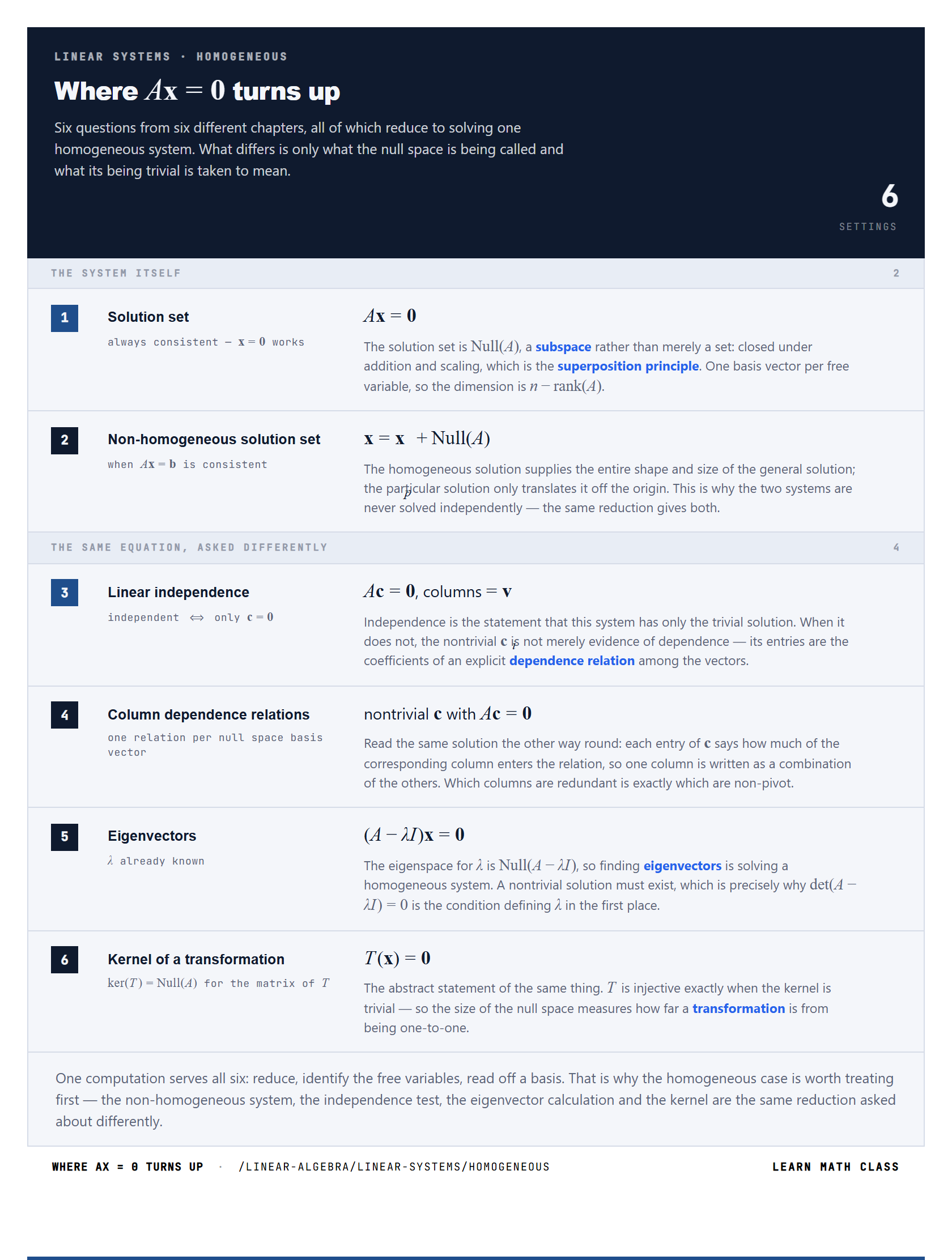
The homogeneous system A·x = 0 shows up far beyond its own statement: every test of linear independence, every eigenvector calculation, every analysis of a non-homogeneous solution set, and every kernel computation reduces to solving one. The table below collects each construction in which homogeneous systems play a role, alongside the specific equation involved and what its solutions represent in that context.
The six settings below are not applications of homogeneous systems so much as the same system wearing different names. In each case something is being asked about a null space, and the only thing that changes is what the trivial solution is taken to mean — no redundancy among vectors, no eigenvector for that scalar, no collapse under the transformation.
Linear systems · homogeneous
Where Ax=0 turns up
Six questions from six different chapters, all of which reduce to solving one homogeneous system. What differs is only what the null space is being called and what its being trivial is taken to mean.
6settings
The system itself2
1always consistent — x=0 works Ax=0 The solution set is Null(A), a subspace rather than merely a set: closed under addition and scaling, which is the superposition principle. One basis vector per free variable, so the dimension is n−rank(A). 2when Ax=b is consistent x=xp+Null(A) The homogeneous solution supplies the entire shape and size of the general solution; the particular solution only translates it off the origin. This is why the two systems are never solved independently — the same reduction gives both.
The same equation, asked differently4
3independent ⟺ only c=0 Ac=0, columns =vi Independence is the statement that this system has only the trivial solution. When it does not, the nontrivial c is not merely evidence of dependence — its entries are the coefficients of an explicit dependence relation among the vectors. 4one relation per null space basis vector
nontrivial c with Ac=0 Read the same solution the other way round: each entry of c says how much of the corresponding column enters the relation, so one column is written as a combination of the others. Which columns are redundant is exactly which are non-pivot. 5(A−λI)x=0 The eigenspace for λ is Null(A−λI), so finding eigenvectors is solving a homogeneous system. A nontrivial solution must exist, which is precisely why det(A−λI)=0 is the condition defining λ in the first place. 6ker(T)=Null(A) for the matrix of T T(x)=0 The abstract statement of the same thing. T is injective exactly when the kernel is trivial — so the size of the null space measures how far a transformation is from being one-to-one. Two of these are worth reading together, because they are the same solution used twice. Solving Ac=0 answers whether the columns are independent, and when the answer is no, the vector c is not merely a witness to dependence — its entries are the coefficients of the relation. The test and the explanation come from one computation, which is why nothing further is needed once the null space basis is in hand. The eigenvector row is where the ordering matters. (A−λI)x=0 is only worth solving once λ is known, and λ is chosen precisely so that this system has a nontrivial solution — which is what det(A−λI)=0 asserts. The characteristic equation exists to make the homogeneous system interesting; the eigenvector calculation that follows is ordinary null space work.