Beyond characterizing invertibility, determinants provide explicit closed-form tools for solving systems, computing inverses, and testing function independence. Each formula trades computational efficiency for structural transparency — the expressions are exact, symbolic, and reveal how solutions depend on the entries of the matrix.
Cramer's Rule
Given a linear systemAx=b where A is n×n with det(A)=0, Cramer's rule expresses each component of the solution directly as a ratio of determinants:
The solution is x1=−23/(−15)=23/15, x2=1/(−15)=−1/15, x3=−26/(−15)=26/15.
Theoretical Significance
Cramer's rule proves that each solution component is a rational function of the matrix entries and the right-hand side entries. This has consequences in pure algebra and in sensitivity analysis, where it shows how solutions respond to perturbations in the data. As a computational method, however, it requires n+1 determinant evaluations, making it far more expensive than Gaussian elimination for large systems.
Component
Column replaced by b in A
det(Ai)
xi = det(Ai) / det(A)
x1
column 1 → b = (5, 0, 3)
−23
23 / 15
x2
column 2 → b = (5, 0, 3)
1
−1 / 15
x3
column 3 → b = (5, 0, 3)
−26
26 / 15
One column swapped for the right-hand side
The column belonging to the unknown being solved for has been replaced by the constants, and the determinant of that altered matrix divided by the original gives the value. Each unknown costs its own determinant, which is why the rule is elegant for two or three and unusable beyond. Solve a full system with it on the Cramer's rule visualizer.
The rule is a statement about structure rather than a practical method; elimination beats it for anything you would actually solve.
Determinant Application Notation
Notation
Determinant Application Notation
Subscripts on this page rarely mean what subscripts usually mean. Four of them name a constructed matrix, a matrix size, a condition on pairs, and a point of evaluation.
The operator spelling det(A), the bar delimiters ∣A∣ and the Δx/Δ tradition of Cramer's own school belong to determinant properties. Minors, cofactors and the transpose hidden inside adj(A) are set out at cofactor expansion, the i^j^k^ row and the symbolic-determinant device at the cross product, and p(λ)=det(A−λI) at the characteristic equation.
x_i = \frac{\det(A_i)}{\det(A)}
x sub i is the determinant of A sub i over the determinant of A
Ai is not an entry, a row, a column or a member of a sequence. It is a whole matrix built for the occasion: A with its i-th column thrown away and b put in its place, every other column untouched. The subscript names a construction the notation never describes.
CasesThe two subscripts in the formula do different jobs. On the left, i selects a component of the solution; on the right, the same i selects which column was replaced. They match because the rule pairs them, not because the symbols are the same kind of thing.
Also writtenCramer's own school writes Δ for the coefficient determinant and Δx, Δy for the replaced ones, naming the columns by the unknown rather than by number.
Do not confuseReading Ai as a submatrix, in the way that deleting a row and column produces one for a minor. Nothing is deleted here: Ai is the same size as A, and the replacement is a substitution rather than a removal.
W(f_1, \dots, f_n)(x)
the Wronskian of f one through f n, evaluated at x
Two bracketed lists in a row, and they hold different kinds of thing. The first takes the functions and fixes which determinant is being formed; the second supplies the point at which that determinant is worked out. W consumes functions and returns a function, so the answer varies with x and a single number is never the whole object.
CasesInside the matrix, one symbol carries two indices with unrelated jobs: in f1(n−1) the subscript picks the function and the parenthesised superscript gives the order of differentiation. The parentheses are what keep it from reading as a power.
Also writtenShortened to W(x) once the functions are fixed by context, which hides the first list entirely and makes the object look like an ordinary function of one variable.
Do not confuseTesting the value at one convenient point and concluding dependence when it comes out zero. A single nonzero value proves independence; vanishing everywhere proves nothing unless the functions are already known to solve one linear differential equation.
\det(V) = \prod_{1 \leq i < j \leq n} (x_j - x_i)
the product over all pairs i less than j between one and n, of x j minus x i
What sits under the product sign is a condition, not a counter running from a start to a finish. It selects every pair of indices with i below j and multiplies one factor for each, which is (2n) factors rather than n.
CasesThe condition also fixes the order inside each factor: the larger index comes first, so every difference is written xj−xi. Swapping them in one factor flips the sign of the whole product, which is why the inequality is part of the notation rather than a remark about it.
Also writtenSpelled out as ∏i<j when the range 1 to n is clear, and occasionally as a nested double product, which obscures that each pair is counted once.
Do not confuseReading it as a single-index product and expecting n factors. For four nodes the formula has six, and the count is the first thing to check when a hand computation disagrees.
D_n = a_nD_{n-1} - b_nc_nD_{n-2}
D sub n equals a sub n times D sub n minus one, minus b sub n c sub n times D sub n minus two
The subscript on D is a matrix size. Dn is the determinant of the n×n tridiagonal matrix, Dn−1 the determinant of a smaller one, so the recurrence relates numbers coming from matrices of three different dimensions in a single line.
CasesThe subscripts on a, b and c mean something else in the same equation: they locate entries within one matrix. Two subscript conventions sit side by side, and only the letter tells them apart.
Also writtenWritten det(Tn) when the matrices are named explicitly, which makes the size-indexing visible at the cost of a longer line.
Do not confuseTreating Dn−1 and Dn−2 as earlier values of one fixed matrix, in the way a sequence recurrence usually works. Each term here belongs to a different matrix, and the family has to be defined before the recurrence means anything.
Same glyph elsewhereD names a diagonal matrix at diagonalization and a scalar determinant here, and the letter is also the older rival to Δ in the Cramer tradition.
The adjugate is the transpose of the cofactor matrix:
adj(A)=16−2−2146−31
So A−1=13116−2−2146−31.
Verification: A⋅A−1 should produce the identity. The (1,1) entry is 131(1⋅1+2⋅6+0⋅(−2))=1313=1. The (1,2) entry is 131(1⋅(−2)+2⋅1+0⋅4)=130=0. The remaining entries check out similarly.
Practical Assessment
The adjugate formula writes every entry of the inverse as an explicit ratio of cofactors and the determinant. This is valuable for symbolic work — it shows exactly how each entry of A−1 depends on the entries of A. For numerical computation on matrices larger than 3×3, row reduction is vastly more efficient.
The cofactor array, before transposing
Transposing this array and dividing by the determinant produces the inverse, which puts the invertibility condition in plain view: every step works until the division, and the division fails precisely when the determinant is zero. Follow it through to the finished inverse on the matrix inverse visualizer.
The same warning applies here: exact, illuminating, and far too expensive to use beyond small matrices.
The Cross Product as a Determinant
The cross product of two vectors a=(a1,a2,a3) and b=(b1,b2,b3) in R3 can be computed as a symbolic 3×3 determinant:
a×b=deti^a1b1j^a2b2k^a3b3
Expanding along the first row using the cofactor formula:
Each component of the resulting vector is a 2×2 minor — the sub-determinant obtained by deleting the appropriate row and column from the lower two rows.
This is a formal rather than literal use of the determinant. The first row contains basis vectors, not numbers, so the "determinant" is not a scalar but a vector. The cofactor expansion still applies mechanically, and the alternating signs +,−,+ produce the correct cross product components.
The magnitude is ∣a×b∣=4+256+16=276=269. This equals the area of the parallelogram spanned by a and b, connecting the cross product back to the geometric interpretation of the determinant as an area measure.
The cross product written as a determinant
Basis vectors occupy the first row and the two operands fill the other two, so the cross product is a cofactor expansion wearing different clothes. The alternating sign board is what puts the minus on the middle component, and the whole thing vanishing means the two rows were proportional — that is, the vectors were parallel. Expand it yourself on the cross product visualizer.
Seen this way the cross product is not a new operation at all but a determinant with a basis row bolted on.
The Characteristic Polynomial
For an n×n matrix A, the characteristic polynomial is defined as
p(λ)=det(A−λI)
This is a polynomial of degree n in the variable λ. Its roots are the eigenvalues of A — the scalars λ for which the matrix A−λI becomes singular.
2×2 Example
For A=(4213):
A−λI=(4−λ213−λ)
p(λ)=(4−λ)(3−λ)−2=λ2−7λ+10=(λ−2)(λ−5)
The eigenvalues are λ=2 and λ=5.
3×3 Example
For A=200130011:
This is upper triangular, so A−λI is also upper triangular with diagonal entries 2−λ, 3−λ, 1−λ. The determinant of a triangular matrix is the product of its diagonal entries:
p(λ)=(2−λ)(3−λ)(1−λ)
The eigenvalues are λ=1,2,3 — they sit directly on the diagonal, which is always the case for triangular matrices.
Two Identities
Setting λ=0 in the characteristic polynomial gives p(0)=det(A), which means the constant term of the characteristic polynomial is the determinant. Since the roots of p are the eigenvalues λ1,…,λn, this yields
The determinant equals the product of all eigenvalues, counted with algebraic multiplicity. A second identity connects the coefficient of λn−1 to the trace:
λ1+λ2+⋯+λn=tr(A)
Together, these two identities link the determinant and trace to the eigenvalue spectrum of the matrix.
The Wronskian
The Wronskian extends the determinant's role as a linear independence test from vectors to functions. Given n functions f1,f2,…,fn, each differentiable at least n−1 times, the Wronskian is
Each column corresponds to one function, and each row raises the order of differentiation by one. The result is a function of x, not a constant.
The Independence Test
If W(f1,…,fn)(x0)=0 at some point x0, then the functions f1,…,fn are linearly independent on any interval containing x0. The logic mirrors the matrix case: a nonzero determinant means the "columns" — here the function-derivative profiles — are not proportional.
The converse requires care. A Wronskian that vanishes everywhere does not automatically imply dependence unless the functions are known to be solutions of a single linear ordinary differential equation. Without that structural assumption, counterexamples exist.
Worked Example
Take f1=ex, f2=e2x, f3=e3x. The Wronskian matrix is
exexexe2x2e2x4e2xe3x3e3x9e3x
Factoring ex from column 1, e2x from column 2, and e3x from column 3:
W=e6xdet111124139
The remaining matrix is a Vandermonde matrix with nodes 1,2,3. Its determinant is (2−1)(3−1)(3−2)=1⋅2⋅1=2. So W=2e6x, which is nonzero for all x, confirming that ex,e2x,e3x are linearly independent.
Context
The Wronskian arises most naturally in the theory of linear ordinary differential equations, where it determines whether a proposed set of solutions forms a fundamental system. Abel's identity gives a differential equation for the Wronskian itself, relating its evolution to the coefficient in the ODE. These developments belong to differential equations rather than linear algebra, but the underlying mechanism — testing independence via a determinant — is purely algebraic.
Vandermonde and Structured Determinants
Certain matrices with patterned entries have determinants that admit elegant closed-form expressions. The most important of these is the Vandermonde matrix.
The Vandermonde Determinant
An n×n Vandermonde matrix is built from n distinct nodes x1,x2,…,xn:
The product runs over all pairs with j>i, so it contains (2n) factors. Each factor is a difference between two nodes.
3×3 Verification
For nodes x1=1, x2=2, x3=4:
V=1111241416
Direct expansion: det(V)=1(32−16)−1(16−4)+1(4−2)=16−12+2=6.
The product formula: (x2−x1)(x3−x1)(x3−x2)=(2−1)(4−1)(4−2)=1⋅3⋅2=6.
Why It Matters
The Vandermonde determinant is nonzero precisely when all nodes are distinct. This guarantees that a polynomial of degree at most n−1 is uniquely determined by its values at n distinct points — the theoretical foundation of polynomial interpolation. It also appears in the theory of symmetric polynomials and in the derivation of various discrete orthogonality relations.
Other Structured Determinants
Several other matrix families have known determinant formulas. Circulant matrices, built from cyclic shifts of a single row, have determinants expressible through the discrete Fourier transform: if the first row is (c0,c1,…,cn−1), then det(C)=∏k=0n−1p(ωk) where p(x)=c0+c1x+⋯+cn−1xn−1 and ω=e2πi/n is a primitive n-th root of unity.
Hilbert matrices, with entries Hij=i+j−11, have a closed-form determinant involving products of factorials. These matrices are notoriously ill-conditioned — their determinants shrink rapidly as n grows, reflecting extreme sensitivity to perturbation.
Tridiagonal matrices, with nonzero entries only on the main diagonal and the two adjacent diagonals, have determinants satisfying a three-term recurrence: if Dn denotes the determinant of the n×n tridiagonal matrix, then Dn=anDn−1−bncnDn−2, where an is the n-th diagonal entry and bn,cn are the adjacent off-diagonal entries. This recurrence allows O(n) computation, much faster than general methods.
Each of these families illustrates the same principle: when a matrix has special structure, its determinant often has a formula that exploits that structure directly, bypassing both cofactor expansion and row reduction.
Family
Structure
Determinant formula
Key property / use
Vandermonde
entry Vij = xij−1; columns are 1, x, x², …, xn−1
∏i < j (xj − xi)
nonzero iff nodes are distinct → unique polynomial interpolation
Circulant
each row is a cyclic shift of the first row (c0, c1, …, cn−1)
∏k=0n−1 p(ωk), where p(x) = Σ cj xj and ω = e2πi/n
diagonalized by the discrete Fourier transform
Hilbert
entry Hij = 1 / (i + j − 1)
closed form involving products of factorials; shrinks rapidly with n
notoriously ill-conditioned; benchmark for numerical sensitivity
Tridiagonal
nonzero entries only on the main diagonal and the two adjacent diagonals
three-term recurrence Dn = an Dn−1 − bn cn Dn−2
O(n) computation — much faster than general methods
Summary: Determinant Applications at a Glance
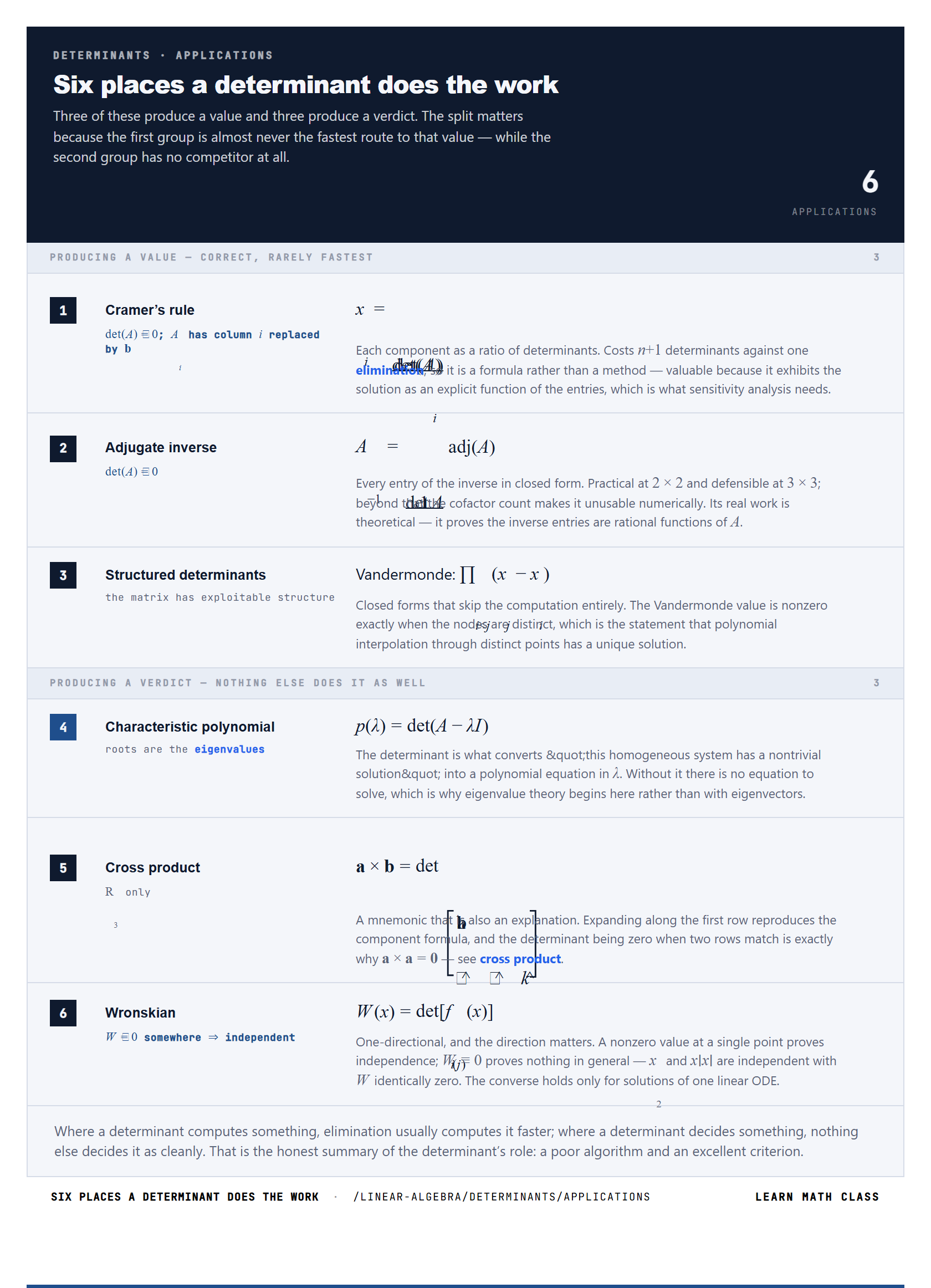
The six applications above span linear systems, inverses, vector geometry, eigenvalue analysis, function-space independence, and structured matrix families. The table below collects each one alongside what the determinant produces, the key formula that drives it, and the situation in which it is the right tool to reach for.
The six uses below divide along a line that is easy to miss when they are listed together. In the first group the determinant produces a number that something else could have produced faster; in the second it produces a decision that nothing else produces at all. Reading them as one undifferentiated list of applications tends to leave the impression that determinants are a computational tool, which is close to the opposite of the truth.
Three of these produce a value and three produce a verdict. The split matters because the first group is almost never the fastest route to that value — while the second group has no competitor at all.
Each component as a ratio of determinants. Costs n+1 determinants against one elimination, so it is a formula rather than a method — valuable because it exhibits the solution as an explicit function of the entries, which is what sensitivity analysis needs.
Every entry of the inverse in closed form. Practical at 2×2 and defensible at 3×3; beyond that the cofactor count makes it unusable numerically. Its real work is theoretical — it proves the inverse entries are rational functions of A.
Closed forms that skip the computation entirely. The Vandermonde value is nonzero exactly when the nodes are distinct, which is the statement that polynomial interpolation through distinct points has a unique solution.
Producing a verdict — nothing else does it as well3
The determinant is what converts "this homogeneous system has a nontrivial solution" into a polynomial equation in λ. Without it there is no equation to solve, which is why eigenvalue theory begins here rather than with eigenvectors.
A mnemonic that is also an explanation. Expanding along the first row reproduces the component formula, and the determinant being zero when two rows match is exactly why a×a=0 — see cross product.
One-directional, and the direction matters. A nonzero value at a single point proves independence; W≡0 proves nothing in general — x2 and x∣x∣ are independent with W identically zero. The converse holds only for solutions of one linear ODE.
Where a determinant computes something, elimination usually computes it faster; where a determinant decides something, nothing else decides it as cleanly. That is the honest summary of the determinant’s role: a poor algorithm and an excellent criterion.
Cramer's rule and the adjugate inverse are the clearest cases. Both are correct, both are taught, and both are slower than elimination by a margin that grows with n — Cramer's rule needs n+1 determinants where elimination needs one pass. What they offer instead is a closed form: the solution written as an explicit function of the matrix entries, which is what makes them useful for symbolic work and for asking how the answer responds when an entry changes.
The second group has no such competitor. The characteristic polynomial exists because the determinant turns a statement about nontrivial solutions into a polynomial equation, and without that step there is nothing to solve for. The Wronskian tests something no elimination can reach, since its entries are functions rather than numbers. These are the applications that justify the determinant rather than merely using it.
Determinant Applications FAQ
In Cramer's rule, is Ai a smaller matrix?
+
No, it is exactly the same size as A. The subscript marks a substitution rather than a deletion: column i has been replaced by the constant vector, and everything else is untouched. That distinguishes it from a minor, where a row and a column really are removed and the result genuinely shrinks.Read more →
Does a Wronskian of zero prove that functions are dependent?
+
No, and this is the usual overstatement. The implication runs one way only: a single nonzero value proves independence. Vanishing everywhere proves nothing on its own, and only becomes conclusive when the functions are already known to solve one linear differential equation. Testing one convenient point settles nothing either way.Read more →
How many factors does a Vandermonde determinant have?
+
One for every pair of nodes, so (2n) rather than n. Four nodes give six factors, not four, and miscounting is the first thing to check when a hand computation disagrees. The ordering matters too: each difference is written with the larger index first, since swapping one factor flips the sign of the whole product.Read more →