Visual Tools
Calculators
Tables
Mathematical Keyboard
Converters
Other Tools


Determinant as Area and Volume


Area, Volume, and Orientation

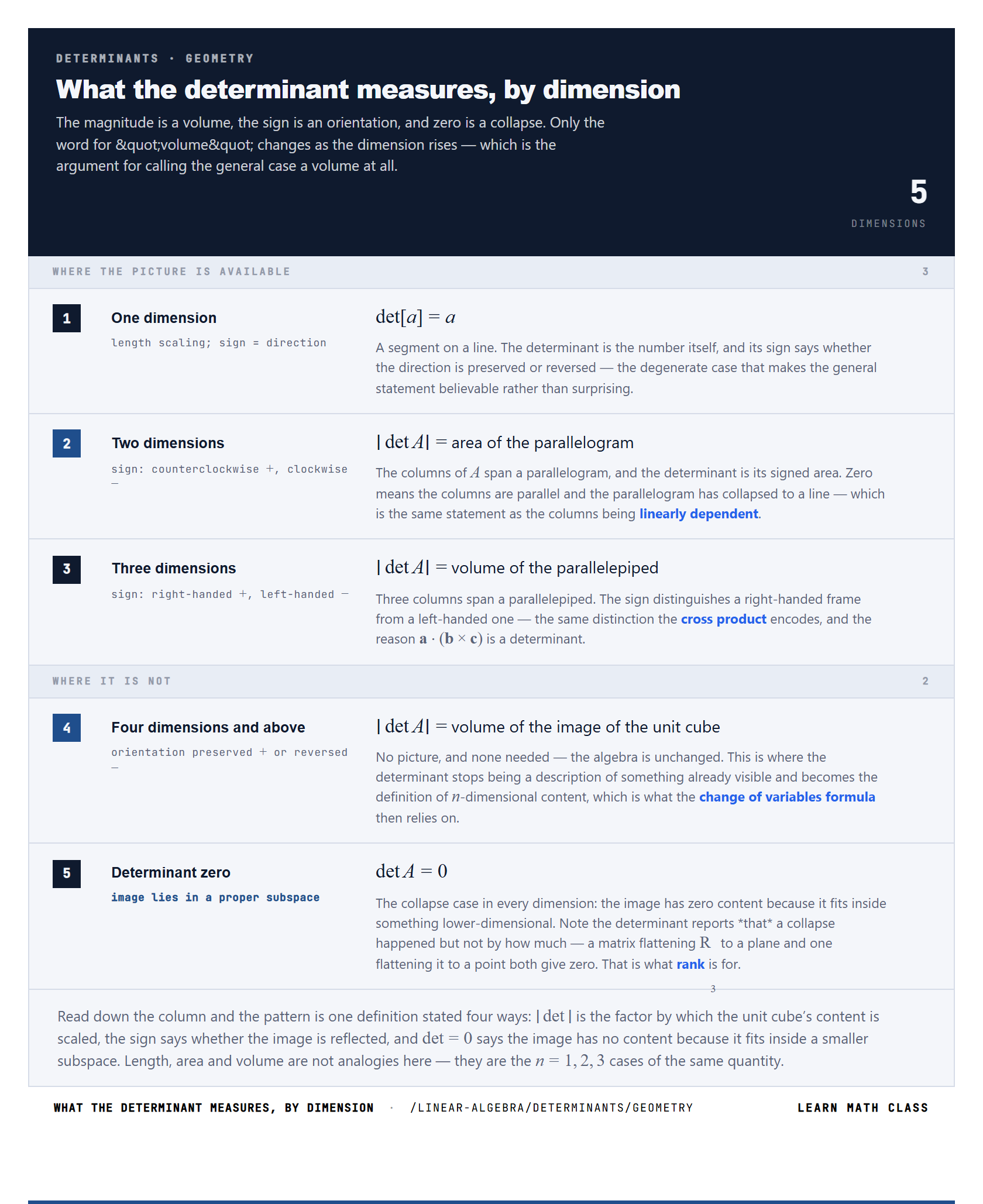
The determinant measures how a linear transformation scales regions and whether it preserves or reverses their orientation. This geometric reading connects an algebraic formula to spatial intuition, turning abstract sign patterns and products into statements about parallelograms, parallelepipeds, and higher-dimensional volumes.


Signed Area in Two Dimensions

The columns of a 2×22 \times 2 matrix AA define two vectors in R2\mathbb{R}^2 emanating from the origin. These vectors span a parallelogram, and the determinant of AA equals the signed area of that parallelogram.

For A=(abcd)A = \begin{pmatrix} a & b \\ c & d \end{pmatrix}, the columns are u=(a,c)\mathbf{u} = (a, c) and v=(b,d)\mathbf{v} = (b, d). The unsigned area of the parallelogram they span can be computed from the cross product magnitude in three dimensions by embedding both vectors with a zero third component, but in two dimensions the formula reduces directly to

signed area=adbc=det(A)\text{signed area} = ad - bc = \det(A)


The sign encodes orientation. When det(A)>0\det(A) > 0, the pair (u,v)(\mathbf{u}, \mathbf{v}) follows the standard counterclockwise ordering — rotating from u\mathbf{u} toward v\mathbf{v} sweeps counterclockwise. When det(A)<0\det(A) < 0, the pair is clockwise. When det(A)=0\det(A) = 0, the two vectors are parallel and the parallelogram degenerates to a line segment with zero area.

Example


For A=(3104)A = \begin{pmatrix} 3 & 1 \\ 0 & 4 \end{pmatrix}, the columns are (3,0)(3, 0) and (1,4)(1, 4). The determinant is 3410=123 \cdot 4 - 1 \cdot 0 = 12. The parallelogram has area 1212, and since the sign is positive, the columns are counterclockwise-ordered.

For A=(1340)A = \begin{pmatrix} 1 & 3 \\ 4 & 0 \end{pmatrix}, the determinant is 1034=121 \cdot 0 - 3 \cdot 4 = -12. The area is still 1212, but the negative sign means the columns are clockwise-ordered — swapping the columns reversed the orientation.

Signed Volume in Three Dimensions

Three vectors in R3\mathbb{R}^3 span a parallelepiped — the three-dimensional analogue of a parallelogram. Arranging these vectors as columns of a 3×33 \times 3 matrix AA, the determinant equals the signed volume of that parallelepiped.

This is identical to the scalar triple product. If the columns of AA are a\mathbf{a}, b\mathbf{b}, c\mathbf{c}, then

det(A)=a(b×c)\det(A) = \mathbf{a} \cdot (\mathbf{b} \times \mathbf{c})


The dot product projects a\mathbf{a} onto the direction perpendicular to the base parallelogram spanned by b\mathbf{b} and c\mathbf{c}, and b×c|\mathbf{b} \times \mathbf{c}| gives the base area. Their product is the volume.

The sign reflects handedness. When det(A)>0\det(A) > 0, the three column vectors form a right-handed system — the same orientation as the standard basis e1,e2,e3\mathbf{e}_1, \mathbf{e}_2, \mathbf{e}_3. When det(A)<0\det(A) < 0, they form a left-handed system. When det(A)=0\det(A) = 0, the three vectors are coplanar and the parallelepiped is flat.

Example


Let a=(1,0,0)\mathbf{a} = (1, 0, 0), b=(0,2,0)\mathbf{b} = (0, 2, 0), c=(0,0,3)\mathbf{c} = (0, 0, 3). The matrix A=(100020003)A = \begin{pmatrix} 1 & 0 & 0 \\ 0 & 2 & 0 \\ 0 & 0 & 3 \end{pmatrix} has det(A)=6\det(A) = 6. The parallelepiped is an axis-aligned box with side lengths 1,2,31, 2, 3 and volume 66, oriented right-handedly.

Swapping two columns — say placing b\mathbf{b} first and a\mathbf{a} second — gives det=6\det = -6. The volume is unchanged, but the orientation flips to left-handed.

The General Case: n-Dimensional Volume Scaling

The pattern generalizes to arbitrary dimension. For an n×nn \times n matrix AA, the absolute value det(A)|\det(A)| is the factor by which the linear map xAxx \mapsto Ax scales nn-dimensional volumes.

More precisely, consider the unit hypercube in Rn\mathbb{R}^n — the set of all vectors whose components lie between 00 and 11. Its nn-dimensional volume is 11. The image of this hypercube under the map xAxx \mapsto Ax is a parallelepiped whose nn-dimensional volume equals det(A)|\det(A)|.

This scaling factor applies uniformly to every region, not just the unit hypercube. If SS is any measurable subset of Rn\mathbb{R}^n with volume VV, then the image A(S)={Ax:xS}A(S) = \{Ax : x \in S\} has volume det(A)V|\det(A)| \cdot V.

Three regimes emerge from this interpretation. When det(A)>1|\det(A)| > 1, the map expands volumes. When 0<det(A)<10 < |\det(A)| < 1, it compresses volumes. When det(A)=1|\det(A)| = 1, volumes are preserved — the map is volume-preserving. Rotations and reflections both fall in this last category.

When det(A)=0\det(A) = 0, the map collapses at least one dimension entirely. The image of Rn\mathbb{R}^n under a singular matrix is a subspace of dimension less than nn — a hyperplane, a line, a point, or something in between — and all nn-dimensional volumes map to zero.

Orientation

The sign of the determinant carries information that the absolute value discards. A positive determinant means the linear map preserves the orientation of Rn\mathbb{R}^n; a negative determinant means it reverses orientation.

In two dimensions, orientation is the sense of rotation. A positively oriented pair of vectors goes counterclockwise; a negatively oriented pair goes clockwise. A linear map with det(A)>0\det(A) > 0 sends every counterclockwise pair to another counterclockwise pair. A map with det(A)<0\det(A) < 0 flips counterclockwise to clockwise.

In three dimensions, orientation is handedness. The standard basis is right-handed. A transformation with positive determinant sends right-handed triples to right-handed triples; a transformation with negative determinant sends them to left-handed triples.

Standard examples make the distinction concrete. A rotation matrix in R2\mathbb{R}^2 or R3\mathbb{R}^3 always has det=+1\det = +1 — it preserves both volume and orientation. A reflection across a line (in R2\mathbb{R}^2) or a plane (in R3\mathbb{R}^3) has det=1\det = -1 — it preserves volume but flips orientation. An improper rotation, which composes a rotation with a reflection, also has det=1\det = -1.

When det(A)=0\det(A) = 0, orientation is undefined. The map crushes the space down to a lower-dimensional image, and the concept of clockwise versus counterclockwise or right-handed versus left-handed no longer applies in the collapsed image.

Linear Transformations as Geometric Mappings

Every invertible n×nn \times n matrix defines a bijective linear transformation from Rn\mathbb{R}^n to itself. The determinant captures the two essential geometric facts about this transformation in a single number: it scales all volumes by det(A)|\det(A)|, and it either preserves or reverses orientation according to the sign.

The multiplicative property det(AB)=det(A)det(B)\det(AB) = \det(A)\det(B) takes on a clean geometric reading in this context. Composing two linear maps multiplies their volume-scaling factors: if AA scales volumes by det(A)|\det(A)| and BB scales by det(B)|\det(B)|, then ABAB scales by det(A)det(B)|\det(A)| \cdot |\det(B)|. The orientation effects compose as well — two orientation-reversing maps compose to an orientation-preserving one, matching the sign rule (1)(1)=+1(-1)(-1) = +1.

The inverse A1A^{-1} undoes both effects. Its determinant is det(A1)=1/det(A)\det(A^{-1}) = 1/\det(A), so it scales volumes by the reciprocal factor and restores whatever orientation AA may have flipped.

A singular matrix (det=0\det = 0) is a transformation that is not bijective. It maps Rn\mathbb{R}^n onto a proper subspace, losing information in the process. No inverse exists because the collapsed dimensions cannot be recovered.

The Change-of-Variables Formula

The geometric interpretation of the determinant extends beyond linear maps through the change-of-variables formula in multivariable integration. Given a differentiable transformation T:RnRnT: \mathbb{R}^n \to \mathbb{R}^n, the formula reads

f(y)dy=f(T(x))det(JT(x))dx\int f(\mathbf{y}) \, d\mathbf{y} = \int f(T(\mathbf{x})) \, |\det(J_T(\mathbf{x}))| \, d\mathbf{x}


where JT(x)J_T(\mathbf{x}) is the Jacobian matrix of TT at the point x\mathbf{x} — the n×nn \times n matrix of all partial derivatives Tixj\frac{\partial T_i}{\partial x_j}.

The Jacobian matrix is the best linear approximation to TT near x\mathbf{x}. At each point, it acts like a linear transformation on a small neighborhood, and its determinant measures the local volume distortion. The absolute value appears because the integral accumulates unsigned volume — areas and volumes are always non-negative regardless of orientation.

In single-variable calculus, the substitution rule f(g(x))g(x)dx\int f(g(x)) \, g'(x) \, dx uses the derivative g(x)g'(x) as a one-dimensional scaling factor. The Jacobian determinant is the natural generalization: g(x)g'(x) is a 1×11 \times 1 "determinant," and det(JT)|\det(J_T)| plays the same role in nn dimensions.

The most familiar instances are polar coordinates in R2\mathbb{R}^2, where the Jacobian determinant is rr, and spherical coordinates in R3\mathbb{R}^3, where it is r2sinϕr^2 \sin\phi. Both factors arise from computing det(JT)\det(J_T) for the respective coordinate transformations.

Area and Volume Formulas from Determinants

The geometric interpretation yields direct coordinate-based formulas for the areas and volumes of common shapes.

Triangle Area


Given three vertices (x1,y1)(x_1, y_1), (x2,y2)(x_2, y_2), (x3,y3)(x_3, y_3) in the plane, the area of the triangle they form is

Area=12det(x2x1x3x1y2y1y3y1)\text{Area} = \frac{1}{2} \left| \det\begin{pmatrix} x_2 - x_1 & x_3 - x_1 \\ y_2 - y_1 & y_3 - y_1 \end{pmatrix} \right|


The 2×22 \times 2 matrix has as its columns the edge vectors from vertex 11 to the other two vertices. The determinant gives the signed area of the parallelogram spanned by these edges, and the triangle occupies exactly half of that parallelogram.

For the vertices (1,2)(1, 2), (4,6)(4, 6), (3,1)(3, 1): the edge vectors are (3,4)(3, 4) and (2,1)(2, -1), the determinant is 3(1)4(2)=113(-1) - 4(2) = -11, and the area is 112\frac{11}{2}.

Parallelogram Area


The parallelogram spanned by vectors u\mathbf{u} and v\mathbf{v} in R2\mathbb{R}^2 has area det(u  v)|\det(\mathbf{u} \; \mathbf{v})| — the full absolute value of the determinant, without the factor of 12\frac{1}{2}.

Tetrahedron Volume


Given four vertices in R3\mathbb{R}^3, pick one as the origin and form the three edge vectors to the other three. The volume of the tetrahedron is

Volume=16det(e1e2e3)\text{Volume} = \frac{1}{6} \left| \det\begin{pmatrix} \mathbf{e}_1 & \mathbf{e}_2 & \mathbf{e}_3 \end{pmatrix} \right|


where e1,e2,e3\mathbf{e}_1, \mathbf{e}_2, \mathbf{e}_3 are the edge vectors arranged as columns. The factor 16\frac{1}{6} arises because a tetrahedron occupies one-sixth of the parallelepiped spanned by its three edges.

For vertices at (0,0,0)(0,0,0), (1,0,0)(1,0,0), (0,2,0)(0,2,0), (0,0,3)(0,0,3): the edge vectors are the standard-scaled basis vectors, the determinant is 66, and the tetrahedron volume is 11.

Parallelepiped Volume


The parallelepiped spanned by three vectors in R3\mathbb{R}^3 has volume equal to the full absolute value of the 3×33 \times 3 determinant formed by those vectors as columns — no fractional factor needed.