Visual Tools
Calculators
Tables
Mathematical Keyboard
Converters
Other Tools


Complex Numbers Basics: From the Imaginary Unit to Polynomial Roots


The Evolution of Numbers: From Counting to Complexity


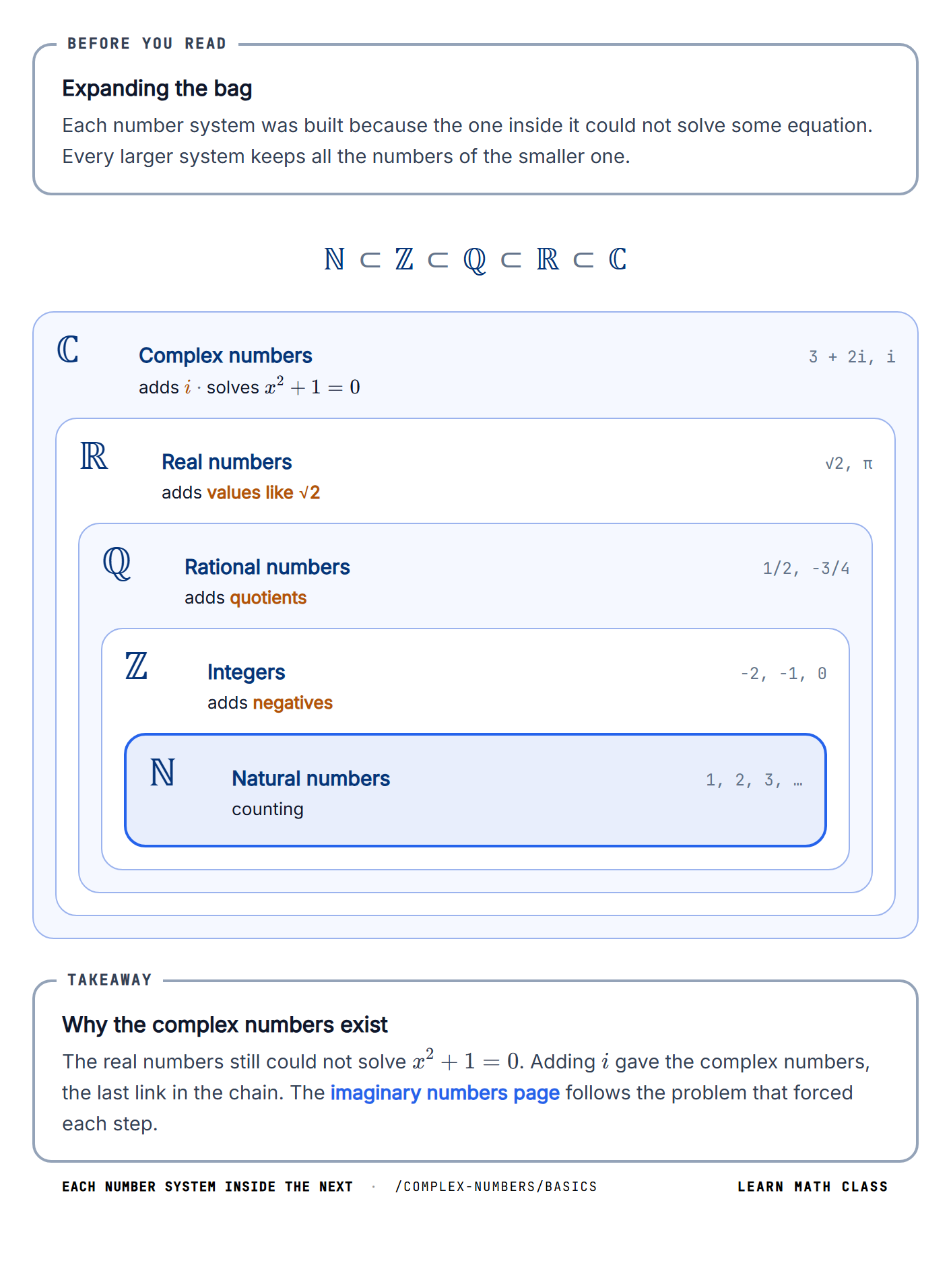
Mathematics began with natural numbers (N\mathbb{N}) for counting, but as we attempted to solve more equations, we had to "expand the bag". We added the integers (Z\mathbb{Z}) for negatives, rational numbers (Q\mathbb{Q}) for quotients, and real numbers (R\mathbb{R}) for values like 2\sqrt{2}. However, the "R-bag" cannot solve the equation x2+1=0x^2 + 1 = 0; the Complex Numbers (C\mathbb{C}) can. The imaginary numbers page draws the whole chain, with the problem that forced each step.
DownloadPNG2×PDF
Before you read
Expanding the bag
Each number system was built because the one inside it could not solve some equation. Every larger system keeps all the numbers of the smaller one.

ℕ⊂ℤ⊂ℚ⊂ℝ⊂ℂ

ℂ
Complex numbers
adds ii · solves x2+1=0x^2 + 1 = 0
3 + 2i, i
ℝ
Real numbers
adds values like √2
√2, π
ℚ
Rational numbers
adds quotients
1/2, −3/4
ℤ
Integers
adds negatives
−2, −1, 0
ℕ
Natural numbers
counting
1, 2, 3, …
Takeaway
Why the complex numbers exist
The real numbers still could not solve x2+1=0x^2 + 1 = 0. Adding ii gave the complex numbers, the last link in the chain. The imaginary numbers page follows the problem that forced each step.
Each number system inside the next·/complex-numbers/basicsLearn Math Class

Key Terms

Foundations

Complex Number— a number of the form z=a+biz = a + bi
Imaginary Unit— the number ii satisfying i2=−1i^2 = -1
Imaginary Number— a number of the form bibi with b≠0b \neq 0
Pure Imaginary Number— a complex number with zero real part
Real Part— the component aa in z=a+biz = a + bi
Imaginary Part— the coefficient bb in z=a+biz = a + bi
Algebraic Form— the standard representation z=a+biz = a + bi

Representations

Complex Plane— the two-dimensional plane for visualizing complex numbers
Modulus— the distance ∣z∣|z| from the origin
Argument— the angle θ\theta from the positive real axis
Trigonometric Form— representation as r(cos⁡θ+isin⁡θ)r(\cos\theta + i\sin\theta)
Exponential Form— representation as reiθre^{i\theta}

Operations & Structure

Complex Conjugate— the reflection z‾=a−bi\overline{z} = a - bi
Additive Inverse— the number −z-z that sums to zero
Multiplicative Inverse— the number z−1z^{-1} that multiplies to one
Roots of Unity— solutions to zn=1z^n = 1

See All Complex Numbers Definitions →


The Imaginary Unit (ii) and Pure Imaginary Numbers

The real number system, despite its vastness, cannot solve every equation. The simple polynomial x2+1=0x^2 + 1 = 0 has no solution among real numbers because no real number squared produces a negative result. This limitation is met by a new number: the imaginary unit ii, where i2=−1i^2 = -1.

From this single definition, an entire class of numbers emerges. Pure imaginary numbers take the form bibi where bb is real — examples include 3i3i, −7i-7i, and 12i\frac{1}{2}i. These numbers exist on their own axis, perpendicular to the real number line.

The powers of ii follow a cyclic pattern that repeats every four steps: i1=ii^1 = i, i2=−1i^2 = -1, i3=−ii^3 = -i, i4=1i^4 = 1, then back to ii. This cycle provides a shortcut for computing any power of ii — simply divide the exponent by 4 and use the remainder.
n mod 4 in Examples
0 1 i0 = 1,   i4 = 1,   i8 = 1
1 i i1 = i,   i5 = i,   i9 = i
2 −1 i2 = −1,   i6 = −1,   i10 = −1
3 −i i3 = −i,   i7 = −i,   i11 = −i
ReIm-5−5i-4−4i-3−3i-2−2i-1−1i11i22i33i44i55i0z̅z = 2i
z = 2i on the imaginary axis

The point sits straight up the vertical axis with no horizontal component: a real multiple of i and nothing else, which is what pure imaginary means. Its conjugate, −2i, is directly below it. Slide the point along either axis and read off which part vanishes on the complex number explorer.

The pure imaginary numbers are the vertical axis of the plane introduced below, just as the reals are its horizontal axis.
Learn More

Algebraic Representation and the Complex Conjugate

Real numbers solve x² − 4 = 0, but not x² + 1 = 0: no real number squares to a negative.
The previous section added one new number, ii, with i2=−1i^2 = -1. The question is what numbers become available once ii is allowed to mix with the real numbers.
Equations with no real solutions get solutions of the form a real number plus a real multiple of i.
equationreal solutionssolutions once i is allowed
x² − 4 = 0−2, 2−2, 2
x² + 1 = 0none−i, i
x² + 4 = 0none−2i, 2i
x² − 2x + 5 = 0none1 − 2i, 1 + 2i
The last solutions, 1±2i1 \pm 2i, are neither real nor pure imaginary: they have a real part, 11, and an imaginary part, ±2\pm 2.
The definition
A complex number is a number a+bia + bi with aa and bb real and i2=−1i^2 = -1; aa is its real part and bb its imaginary part.
Every complex number can be written in algebraic form (also called standard form):
Algebraic Form
z=a+biz = a + bi
Learn more about this formula: Algebraic Form →
The variables aa and bb represent ordinary real numbers, while ii is the imaginary unit satisfying:
Algebraic Representation and the Complex Conjugate
i2=−1i^2 = -1
So 1+2i1 + 2i is a complex number with real part 11 and imaginary part 22, and it solves x2−2x+5=0x^2 - 2x + 5 = 0.
A complex number is a pair of real numbers, a and b, written as a single number.
The letters aa and bb are conventional choices — using xx and yy or any other symbols works equally well. The symbols this section builds on — ii, Re(z)Re(z), Im(z)Im(z), zˉ\bar{z} and the rest — are catalogued among the complex number symbols with the LaTeX code for each, and the mathematical keyboard lets you type them directly.
Mathematicians assigned names to these components. The value aa is called the real part, and the value bb is called the imaginary part:
Algebraic Representation and the Complex Conjugate
Re(z)=aandIm(z)=bRe(z) = a \quad \text{and} \quad Im(z) = b
Note that the imaginary part is bb itself — a real number — not bibi. The term "imaginary part" indicates which component of the number the value describes, not the nature of bb as a quantity.
This representation provides the foundation for arithmetic, comparison, and manipulation of complex numbers. For a complete treatment of the algebraic form, including equality conditions, conjugate identities, and classification theorems, see the dedicated page.
Nothing is lost: every real number is a complex number with imaginary part 0.
−2-2 is −2+0i-2 + 0i, so the real solutions in the first row of the table are complex solutions too.
ReIm-10−10i-8−8i-6−6i-4−4i-2−2i22i44i66i88i1010i|z| = 3.6zz̅
z and z̄ mirrored in the real axis, |z| = 3.6

The point z and its conjugate z̄ sit at the same distance from the origin, one above the real axis and one below: conjugation keeps the real part and flips the sign of the imaginary part, so it is a reflection in the real axis. The modulus, the length of either arrow, is the same 3.6 for both. Drag z anywhere and watch its mirror image follow on the conjugate and modulus tool.

For any z=a+biz = a + bi, we construct its conjugate by flipping the sign in front of bb: thus zˉ=a−bi\bar{z} = a - bi. What does this operation actually do? On the complex plane, it mirrors the point through the horizontal axis. Studying this picture makes the abstract definition concrete — the conjugate sits at equal distance from the real axis, but on the opposite side.
Why does this matter? When zz meets zˉ\bar{z} through multiplication, something special occurs: z⋅zˉ=a2+b2z \cdot \bar{z} = a^2 + b^2, a value guaranteed to be real and non-negative. From here, two tests emerge for classification: if z=zˉz = \bar{z}, the number must be real; if zˉ=−z\bar{z} = -z, it must be pure imaginary.
The conjugate operation carries deep significance throughout complex mathematics. It enables division by eliminating imaginary numbers from denominators. It connects directly to the modulus through the identity ∣z∣2=z⋅zˉ|z|^2 = z \cdot \bar{z}. It preserves arithmetic structure: the conjugate of a sum equals the sum of conjugates, and the conjugate of a product equals the product of conjugates. These properties make the conjugate indispensable for proofs, simplifications, and computations across every branch of complex analysis. A dedicated section explores the conjugate in full detail — its properties, its geometric meaning, and its applications to solving equations and simplifying expressions.
The conjugate is the one operation on this page that is a pure reflection.
The imaginary part is the real number b, sign included — not bi.
Pitfall: Dropping the sign of the imaginary part
Reading Im(4−5i)Im(4 - 5i) as 55 drops the minus sign and moves the point from (4,−5)(4, -5) up to (4,5)(4, 5), which is the conjugate. Written as 4+(−5)i4 + (-5)i, the number has Im(z)=−5Im(z) = -5.
The rest of the page covers notation, arithmetic, the complex plane, the polar and exponential forms, and solving equations.
Learn More

Complex Number Notation

Notation

Complex Number Notation

Three marks every complex-numbers page assumes before its own specialized notation begins: the letter that names the number, the two-part form that writes it, and the blackboard-bold symbol for the set holding all of them. The specialized marks live with their owning pages — the strip below says where.
ii itself is defined in The Imaginary Unit above and owned by its dedicated page; the derived marks — Re(z)Re(z), Im(z)Im(z), zˉ\bar{z}, ∣z∣|z|, arg⁡(z)\arg(z) — belong to the algebraic form, conjugate, modulus and trigonometric form pages.
zz · ww
z — a complex number
The standing letter for a complex number, as xx stands for a real unknown. The letter itself is a signal: seeing zz announces that a+bia + bi arithmetic applies before any equation is read. A second number takes ww.
CasesEnumeration falls to subscripts — the z1,z2z_1, z_2 of Arithmetic Operations below; the same labeling job as the roots x1,x2x_1, x_2 of quadratic equations, not the position-in-a-list job of sequences.
Also writtenw=f(z)w = f(z) reserves ww for outputs in complex analysis; engineering's Laplace domain writes its complex variable s=σ+iωs = \sigma + i\omega.
Do not confuseA real variable. Habits imported from the reals fail silently: z2≥0z^2 \geq 0 is false for z=iz = i, and z1<z2z_1 < z_2 is meaningless — complex numbers cannot be ordered, as Geometric Representation below shows.
a+bia + bi
a plus b i
The algebraic form as a mark: aa the real part, bb the coefficient of ii — two real numbers carrying one complex one. The plus is honest addition, yet nothing evaluates: the expression is the finished number.
CasesGeneral work uses a+bia + bi; concrete numbers go literal — 3+2i3 + 2i, −i-i (coefficient 11 suppressed), bare 77 (b=0b = 0 unwritten). The padded spellings 1+0i1 + 0i and 0+0i0 + 0i of The Mathematical Theory below appear only where the classification itself is the point.
Also writtena+iba + ib — the ii-first order, obligatory once the coefficient grows: cos⁡θ+isin⁡θ\cos\theta + i\sin\theta, never cos⁡θ+sin⁡θ i\cos\theta + \sin\theta\, i. Complex analysis prefers x+iyx + iy, matching the plane's coordinates; electrical engineering swaps the unit's letter entirely, writing a+jba + jb.
Do not confuseAn unfinished sum. 3+2i3 + 2i reads like an addition awaiting an answer; it is the answer — the two parts never merge, and the “simplification” (a+b)i(a + b)i is the standard first-week error.
C\mathbb{C}
C — the set of complex numbers
Blackboard bold for the set of every complex number: C={a+bi:a,b∈R}\mathbb{C} = \{a + bi : a, b \in \mathbb{R}\}, the final link in the intro's chain N⊂Z⊂Q⊂R⊂C\mathbb{N} \subset \mathbb{Z} \subset \mathbb{Q} \subset \mathbb{R} \subset \mathbb{C}. The whole double-struck family is catalogued with the set-theory symbols, and the mathematical keyboard carries C\mathbb{C} directly.
CasesMembership declares domain: z∈Cz \in \mathbb{C} opens a statement the way v∈Rn\mathbf{v} \in \mathbb{R}^n does for vectors; superscripted, Cn\mathbb{C}^n names the space of complex nn-tuples.
Also writtenBold upright C\mathbf{C} in older print — blackboard's double stroke began as chalk imitating bold type, then migrated back into books.
Do not confuseR2\mathbb{R}^2. The complex plane and the real plane share their points, but R2\mathbb{R}^2 has no multiplication of points — writing C\mathbb{C} asserts the field structure of The Mathematical Theory below.
Same glyph elsewhereItalic CC is the integration constant of indefinite integrals and the combination count C(n,k)C(n, k) of combinatorics — unrelated jobs; the typeface is the only separator.
DownloadPNG2×PDF
Notation · Cheat sheet
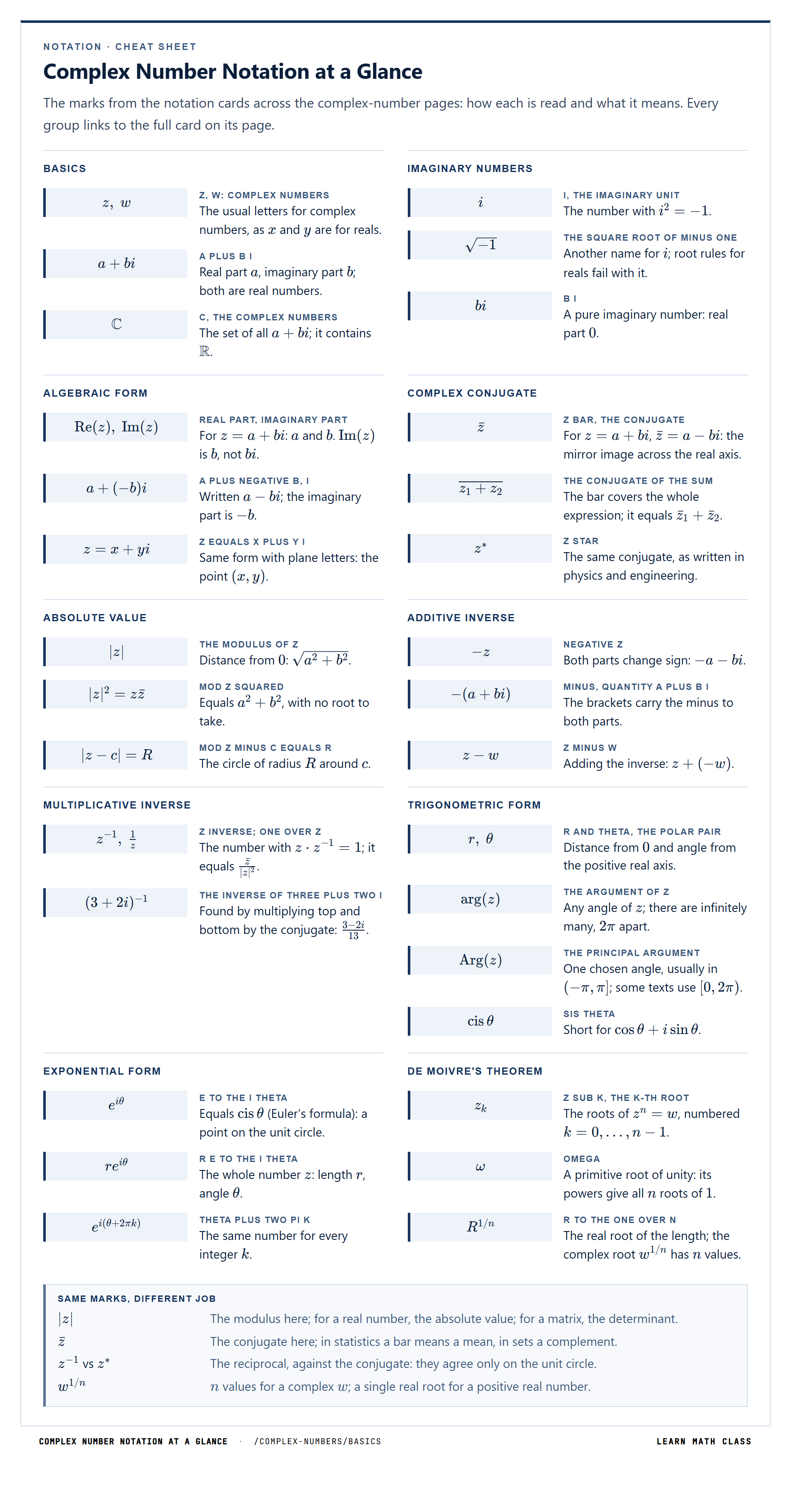
Complex Number Notation at a Glance
The marks from the notation cards across the complex-number pages: how each is read and what it means. Every group links to the full card on its page.
BasicsThis page
z,  wz, \; w
z, w: complex numbers
The usual letters for complex numbers, as xx and yy are for reals.
a+bia + bi
a plus b i
Real part aa, imaginary part bb; both are real numbers.
C\mathbb{C}
C, the complex numbers
The set of all a+bia + bi; it contains R\mathbb{R}.
Imaginary numbers
ii
i, the imaginary unit
The number with i2=−1i^2 = -1.
−1\sqrt{-1}
the square root of minus one
Another name for ii; root rules for reals fail with it.
bibi
b i
A pure imaginary number: real part 00.
Algebraic form
Re⁡(z),  Im⁡(z)\operatorname{Re}(z), \; \operatorname{Im}(z)
real part, imaginary part
For z=a+biz = a + bi: aa and bb. Im⁡(z)\operatorname{Im}(z) is bb, not bibi.
a+(−b)ia + (-b)i
a plus negative b, i
Written a−bia - bi; the imaginary part is −b-b.
z=x+yiz = x + yi
z equals x plus y i
Same form with plane letters: the point (x,y)(x, y).
Complex conjugate
zˉ\bar{z}
z bar, the conjugate
For z=a+biz = a + bi, zˉ=a−bi\bar{z} = a - bi: the mirror image across the real axis.
z1+z2‾\overline{z_1 + z_2}
the conjugate of the sum
The bar covers the whole expression; it equals zˉ1+zˉ2\bar{z}_1 + \bar{z}_2.
z∗z^*
z star
The same conjugate, as written in physics and engineering.
Absolute value
∣z∣|z|
the modulus of z
Distance from 00: a2+b2\sqrt{a^2 + b^2}.
∣z∣2=zzˉ|z|^2 = z\bar{z}
mod z squared
Equals a2+b2a^2 + b^2, with no root to take.
∣z−c∣=R|z - c| = R
mod z minus c equals R
The circle of radius RR around cc.
Additive inverse
−z-z
negative z
Both parts change sign: −a−bi-a - bi.
−(a+bi)-(a + bi)
minus, quantity a plus b i
The brackets carry the minus to both parts.
z−wz - w
z minus w
Adding the inverse: z+(−w)z + (-w).
Multiplicative inverse
z−1,  1zz^{-1}, \; \frac{1}{z}
z inverse; one over z
The number with z⋅z−1=1z \cdot z^{-1} = 1; it equals zˉ∣z∣2\frac{\bar{z}}{|z|^2}.
(3+2i)−1(3 + 2i)^{-1}
the inverse of three plus two i
Found by multiplying top and bottom by the conjugate: 3−2i13\frac{3 - 2i}{13}.
Trigonometric form
r,  θr, \; \theta
r and theta, the polar pair
Distance from 00 and angle from the positive real axis.
arg⁡(z)\arg(z)
the argument of z
Any angle of zz; there are infinitely many, 2π2\pi apart.
Arg⁡(z)\operatorname{Arg}(z)
the principal argument
One chosen angle, usually in (−π,π](-\pi, \pi]; some texts use [0,2π)[0, 2\pi).
cis⁡θ\operatorname{cis}\theta
sis theta
Short for cos⁡θ+isin⁡θ\cos\theta + i\sin\theta.
Exponential form
eiθe^{i\theta}
e to the i theta
Equals cis⁡θ\operatorname{cis}\theta (Euler's formula): a point on the unit circle.
reiθre^{i\theta}
r e to the i theta
The whole number zz: length rr, angle θ\theta.
ei(θ+2πk)e^{i(\theta + 2\pi k)}
theta plus two pi k
The same number for every integer kk.
De Moivre's theorem
zkz_k
z sub k, the k-th root
The roots of zn=wz^n = w, numbered k=0,…,n−1k = 0, \ldots, n - 1.
ω\omega
omega
A primitive root of unity: its powers give all nn roots of 11.
R1/nR^{1/n}
R to the one over n
The real root of the length; the complex root w1/nw^{1/n} has nn values.
Same marks, different job
∣z∣|z|The modulus here; for a real number, the absolute value; for a matrix, the determinant.
zˉ\bar{z}The conjugate here; in statistics a bar means a mean, in sets a complement.
z−1z^{-1} vs z∗z^*The reciprocal, against the conjugate: they agree only on the unit circle.
w1/nw^{1/n}nn values for a complex ww; a single real root for a positive real number.
Complex Number Notation at a Glance·/complex-numbers/basicsLearn Math Class

Arithmetic Operations: Calculating in C\mathbb{C}

The four basic operations extend naturally from real numbers into the complex field, though each carries its own character. Two complex numbers are considered equal only when both their real parts match and their imaginary parts match — the equation a+bi=c+dia + bi = c + di demands a=ca = c and b=db = d simultaneously.

Addition and subtraction work exactly as intuition suggests: combine the real components together, combine the imaginary components together. Given z1=3+2iz_1 = 3 + 2i and z2=1−5iz_2 = 1 - 5i, their sum becomes (3+1)+(2−5)i=4−3i(3 + 1) + (2 - 5)i = 4 - 3i. No new techniques required — just careful bookkeeping of like terms.

Pitfall: Subtracting only the real part
Writing (5+i)−(2−3i)(5 + i) - (2 - 3i) as 5+i−2−3i5 + i - 2 - 3i takes away only the 22 and gives 3−2i3 - 2i. The minus applies to both parts of the second number: 5+i−2+3i=3+4i5 + i - 2 + 3i = 3 + 4i.

Subtraction uses the same bookkeeping: real parts are subtracted from real parts, and imaginary parts from imaginary parts. For the same pair, the real parts give 3−1=23 - 1 = 2 and the imaginary parts give 2−(−5)=72 - (-5) = 7, so z1−z2=2+7iz_1 - z_2 = 2 + 7i, the value listed in the table below. A negative imaginary part in z2z_2 turns that second subtraction into an addition.

Multiplication demands more attention. We apply the distributive property as with any binomial product, but one crucial substitution changes everything: wherever i2i^2 appears, we replace it with −1-1.

Example
The product (2+3i)(4−i)(2 + 3i)(4 - i) expands to 8−2i+12i−3i28 - 2i + 12i - 3i^2, and since i2=−1i^2 = -1, this simplifies to 8+10i+3=11+10i8 + 10i + 3 = 11 + 10i.

Division presents the only genuine challenge. A complex number in the denominator violates standard mathematical convention — we need real denominators for final answers. The solution employs the conjugate: multiply both numerator and denominator by the conjugate of the denominator. This works because z⋅zˉz \cdot \bar{z} always produces a real number. The fraction 3+2i1−4i\frac{3 + 2i}{1 - 4i} transforms through multiplication by 1+4i1+4i\frac{1 + 4i}{1 + 4i}, converting the denominator to the real value 1+16=171 + 16 = 17 and allowing us to express the result in standard a+bia + bi form.

Pitfall: Multiplying only the denominator
Multiplying just the denominator of 3+2i1−4i\frac{3 + 2i}{1 - 4i} by 1+4i1 + 4i gives 3+2i17\frac{3 + 2i}{17}, a different number. Both parts are multiplied: (3+2i)(1+4i)17=−5+14i17\frac{(3 + 2i)(1 + 4i)}{17} = \frac{-5 + 14i}{17}.

Multiplying by 1+4i1+4i\frac{1 + 4i}{1 + 4i} is multiplying by 11, so the value of the fraction does not change, only its form. Once the denominator is real, it divides the real part and the imaginary part of the numerator separately, which puts the answer in standard a+bia + bi form. The table below gives the finished quotient next to the other three operations.
Operation Rule Example
Addition add real parts, add imaginary parts separately (3 + 2i) + (1 − 5i) = 4 − 3i
Subtraction subtract real parts, subtract imaginary parts separately (3 + 2i) − (1 − 5i) = 2 + 7i
Multiplication distribute (FOIL), then replace i2 with −1 (2 + 3i)(4 − i) = 11 + 10i
Division multiply numerator and denominator by the conjugate of the denominator (3 + 2i) ⁄ (1 − 4i) = (−5 + 14i) ⁄ 17
Complex arithmetic is real arithmetic plus one rule, i2=−1i^2 = -1, with the conjugate to clear denominators.
Learn More

Geometric Representation: The Complex Plane

Numbers gain new meaning when we can see them. Every complex number z=a+biz = a + bi corresponds to a unique point (a,b)(a, b) on a two-dimensional plane. The horizontal axis carries the real numbers, the vertical axis carries the pure imaginary numbers, and every other complex number occupies the space between. This visualization, called the complex plane or Argand diagram, transforms abstract algebra into concrete geometry.

The placement of familiar numbers becomes immediate: real numbers like 33 or −2-2 sit directly on the horizontal axis, pure imaginary numbers like 4i4i or −i-i sit on the vertical axis, and the origin represents zero — the only number belonging to both categories simultaneously. A number like 3+2i3 + 2i appears at the point three units right and two units up from the origin.

This geometric perspective reveals structure invisible in pure algebra. The conjugate zˉ\bar{z} appears as a reflection across the real axis. Addition of complex numbers follows the parallelogram rule familiar from vector mathematics. The modulus ∣z∣=a2+b2|z| = \sqrt{a^2 + b^2} measures the straight-line distance from the origin to the point — a direct application of the Pythagorean theorem.

Pitfall: Squaring the whole imaginary term
Putting 4i4i into the formula gives ∣3+4i∣=32+(4i)2=−7|3 + 4i| = \sqrt{3^2 + (4i)^2} = \sqrt{-7}, which is not a distance. The formula uses the imaginary part b=4b = 4: ∣3+4i∣=9+16=5|3 + 4i| = \sqrt{9 + 16} = 5.

For the point 3+4i3 + 4i, the segment from the origin is the hypotenuse of a right triangle. Its horizontal leg runs along the real axis and its vertical leg runs parallel to the imaginary axis, and the lengths of the two legs are the coordinates of the point. The modulus is computed from those two lengths alone.

One fundamental difference separates C\mathbb{C} from R\mathbb{R}: complex numbers cannot be ordered. We cannot say 3+2i3 + 2i is greater than 1+5i1 + 5i in any meaningful way. The real line has direction — numbers increase as we move right — but the complex plane extends in all directions equally. Only the modulus provides a sense of size, measuring how far each number lies from the origin.

THEOREMTriangle Inequality
The Triangle Inequality governs how distances combine: ∣z1+z2∣≤∣z1∣+∣z2∣|z_1 + z_2| \leq |z_1| + |z_2|.

Geometrically, this says the direct path from −z2-z_2 to z1z_1 never exceeds the detour through the origin. This inequality appears constantly in analysis and provides essential bounds for estimation and proof.
ReIm-5−5i-4−4i-3−3i-2−2i-1−1i11i22i33i44i55i0a = 2b = 3|z| = 3.61z̅z = 2 + 3i
z = 2 + 3i plotted as the point (2, 3)

The real part 2 is the horizontal coordinate and the imaginary part 3 the vertical one, so the number is a point in the first quadrant; the arrow from the origin has length |z| = √13 ≈ 3.61. Every complex number is one such point and one such arrow. Move the point through all four quadrants on the complex number explorer.

From here on every algebraic statement about complex numbers has a picture.
Learn More

The Mathematical Theory: Complex Numbers as a Field

Mathematics demands rigor beyond intuition. Before accepting C\mathbb{C} as a legitimate number system, we must verify that it satisfies the structural requirements of a mathematical field. A field is a set equipped with addition and multiplication operations that obey eleven specific axioms — the same rules that govern the rational and real numbers.

The verification proceeds systematically. Addition in C\mathbb{C} is commutative: z1+z2=z2+z1z_1 + z_2 = z_2 + z_1 for any pair of complex numbers. It is also associative: (z1+z2)+z3=z1+(z2+z3)(z_1 + z_2) + z_3 = z_1 + (z_2 + z_3). An additive identity exists — the number 0+0i0 + 0i satisfies z+0=zz + 0 = z for every zz. Every complex number possesses an additive inverse: the negative −z=−a−bi-z = -a - bi fulfills z+(−z)=0z + (-z) = 0.

Fact: Pairs multiply, triples cannot
Hamilton spent years trying to multiply triples a+bi+cja + bi + cj the way C\mathbb{C} multiplies pairs, and it cannot be done: any product of triples that distributes over sums and real multiples has two nonzero factors whose product is 00. In 1843 he succeeded with four parts, the quaternions, whose products depend on the order of the factors.

Multiplication follows parallel rules. The operation is commutative and associative. The multiplicative identity 1+0i1 + 0i satisfies z⋅1=zz \cdot 1 = z. Every nonzero complex number has a multiplicative inverse z−1z^{-1} such that z⋅z−1=1z \cdot z^{-1} = 1. The formula for this inverse employs the conjugate: z−1=zˉ∣z∣2=a−bia2+b2z^{-1} = \frac{\bar{z}}{|z|^2} = \frac{a - bi}{a^2 + b^2}.

The distributive law bridges addition and multiplication: z1⋅(z2+z3)=z1⋅z2+z1⋅z3z_1 \cdot (z_2 + z_3) = z_1 \cdot z_2 + z_1 \cdot z_3. With all eleven axioms confirmed, C\mathbb{C} earns its status as a field — an algebraic structure where arithmetic behaves predictably and division by any nonzero element remains possible.

Yet C\mathbb{C} differs from R\mathbb{R} in one critical respect: it lacks order. No definition of "less than" or "greater than" extends consistently to complex numbers. We cannot arrange them from smallest to largest in a way that agrees with their addition and multiplication. The complex field trades this linear ordering for something arguably more powerful — algebraic completeness, where every polynomial equation finds its solutions.

Trigonometric Representation: Radius and Argument

The algebraic form z=a+biz = a + bi serves well for addition and subtraction, but multiplication and powers become unwieldy as expressions grow complex. A different representation emerges from the geometric perspective: instead of describing where a point lies using horizontal and vertical coordinates, we specify how far it sits from the origin and what angle it makes with the positive real axis.

The distance from the origin is the modulus r=∣z∣=a2+b2r = |z| = \sqrt{a^2 + b^2}, computed through the Pythagorean theorem. The angle θ\theta, called the argument and written arg⁡(z)\arg(z), measures the counterclockwise rotation from the positive real axis to the line connecting the origin to zz. Together, these two values determine the number completely.

The connection between forms follows from basic trigonometry. If a point lies at distance rr and angle θ\theta, its horizontal coordinate equals rcos⁡θr\cos\theta and its vertical coordinate equals rsin⁡θr\sin\theta. Thus z=rcos⁡θ+irsin⁡θz = r\cos\theta + ir\sin\theta, which factors as z=r(cos⁡θ+isin⁡θ)z = r(\cos\theta + i\sin\theta). Mathematicians abbreviate this as z=rcisθz = r\text{cis}\theta, where "cis" stands for "cosine plus i sine."

Converting from algebraic to trigonometric form requires finding both rr and θ\theta. The modulus comes directly from r=a2+b2r = \sqrt{a^2 + b^2}. The argument requires more care: while tan⁡θ=ba\tan\theta = \frac{b}{a} provides a starting point, the actual quadrant of zz determines whether adjustments are needed. A number in the second quadrant has a different argument than one in the fourth, even if both share the same tangent value.

Certain angles deserve memorization. Numbers on the positive real axis have argument 0°0°. Pure positive imaginaries point straight up at 90°90°. Negative reals aim backward at 180°180°. Negative imaginaries point downward at 270°270° or equivalently −90°-90°. Recognizing these special cases accelerates computation and builds geometric intuition for how arguments behave.

The true power of trigonometric form reveals itself in multiplication and division.

RULE
When two numbers multiply, their moduli multiply and their arguments add: z1⋅z2=r1r2cis(θ1+θ2)z_1 \cdot z_2 = r_1 r_2 \text{cis}(\theta_1 + \theta_2).

Division works inversely — moduli divide, arguments subtract. These elegant rules transform tedious algebraic expansion into simple arithmetic on lengths and angles.
ReIm-10−10i-8−8i-6−6i-4−4i-2−2i22i44i66i88i1010iθa = 3b = 2r = 3.61z
z = 3 + 2i: r = 3.61 and the angle θ

The same point described by its distance from the origin, r = √13 ≈ 3.61, and the angle θ it makes with the positive real axis: those two numbers are the modulus and the argument, and together they are the trigonometric form. Convert back and forth for any point on the polar and rectangular form converter.

Modulus and argument are the natural coordinates for multiplication, as the next sections show.
Learn More

Exponential Form and Euler's Formula

The trigonometric form rcisθr\text{cis}\theta simplifies multiplication beautifully, but an even more elegant representation exists. In the eighteenth century, Leonhard Euler discovered a remarkable connection between exponential functions and trigonometry that would reshape mathematics forever: the identity eiθ=cos⁡θ+isin⁡θe^{i\theta} = \cos\theta + i\sin\theta.

Fact: Compounding at an imaginary rate
The number ee is the limit of (1+1n)n(1 + \frac{1}{n})^n, and the same recipe with iπi\pi gives (1+iπn)n→−1(1 + \frac{i\pi}{n})^n \to -1. Each factor turns the point by an angle close to πn\frac{\pi}{n} and barely stretches it, so nn factors make a half-turn; for n=100n = 100 the result is already about −1.05-1.05.

This equation appears almost magical at first glance. The left side involves raising a real number to an imaginary power — an operation with no obvious meaning. Yet when we extend the exponential function into the complex domain through its infinite series expansion, the formula emerges naturally. The real parts collect to form cosine, the imaginary parts assemble into sine, and the equality holds for every real angle θ\theta.

From Euler's formula flows the exponential form of a complex number: z=reiθz = re^{i\theta}, where rr is the modulus and θ\theta is the argument. This notation is mathematically equivalent to rcisθr\text{cis}\theta but carries computational advantages. Standard exponent rules now apply directly to complex arithmetic. Multiplication becomes z1⋅z2=r1r2ei(θ1+θ2)z_1 \cdot z_2 = r_1 r_2 e^{i(\theta_1 + \theta_2)} — we simply multiply the coefficients and add the exponents. Division follows as z1z2=r1r2ei(θ1−θ2)\frac{z_1}{z_2} = \frac{r_1}{r_2}e^{i(\theta_1 - \theta_2)}.

Powers reduce to almost trivial calculation. Raising z=reiθz = re^{i\theta} to the nn-th power yields zn=rneinθz^n = r^n e^{in\theta}. No binomial expansion, no collecting terms, no tracking powers of ii — just raise the modulus to the power and multiply the argument by nn. This efficiency becomes indispensable when computing high powers or extracting roots.

One specialization of Euler's formula achieves legendary status among mathematicians. Setting θ=π\theta = \pi produces eiπ=cos⁡π+isin⁡π=−1e^{i\pi} = \cos\pi + i\sin\pi = -1, which rearranges to eiπ+1=0e^{i\pi} + 1 = 0. This single equation — known as Euler's Identity — connects five of mathematics' most fundamental constants: ee, ii, π\pi, 11, and 00. It unites exponential growth, imaginary numbers, circular geometry, multiplicative identity, and additive identity into one compact statement, often celebrated as the most beautiful formula in all of mathematics.
ReIm-2-2i-1-1i11i22iθcos θr = 1eiθ
e^(iπ) on the unit circle

The point e^(iθ) = cos θ + i sin θ sits on the unit circle at angle θ from the positive real axis. At θ = π the angle is a half turn: cos π = −1 and sin π = 0, so the point lands on −1 and e^(iπ) + 1 = 0. Sweep θ around the circle on the Euler's formula visualizer.

Doubling the angle to 2π brings the point back to 1: e^(2πi) = 1.
Learn More

De Moivre's Theorem and nn-th Order Roots

The exponential form hints at a powerful pattern: raising z=rcisθz = r\text{cis}\theta to the nn-th power multiplies the argument by nn while raising the modulus to that power. Abraham de Moivre formalized this observation into the theorem bearing his name: (cos⁡θ+isin⁡θ)n=cos⁡(nθ)+isin⁡(nθ)(\cos\theta + i\sin\theta)^n = \cos(n\theta) + i\sin(n\theta) for any integer nn. In compact notation, (cisθ)n=cis(nθ)(\text{cis}\theta)^n = \text{cis}(n\theta).

The practical formula extends to any complex number in trigonometric form: zn=rncis(nθ)z^n = r^n\text{cis}(n\theta).

Example
Computing (1+i)20(1 + i)^{20} through algebraic expansion would require enormous effort, but De Moivre's theorem reduces it to routine calculation. First convert: 1+i=2cis(45°)1 + i = \sqrt{2}\text{cis}(45°). Then apply the formula: (2)20cis(20⋅45°)=1024cis(900°)=1024cis(180°)=−1024(\sqrt{2})^{20}\text{cis}(20 \cdot 45°) = 1024\text{cis}(900°) = 1024\text{cis}(180°) = -1024.

What could have been pages of algebra becomes three lines.

The theorem's true depth emerges when we reverse direction and seek roots rather than powers. Given a complex number ww, what values of zz satisfy zn=wz^n = w? The answer reveals geometric elegance: exactly nn distinct roots exist, and they distribute themselves evenly around a circle centered at the origin.

If w=Rcisϕw = R\text{cis}\phi, the nn-th roots follow the formula zk=R1/ncis(ϕ+360°kn)z_k = R^{1/n}\text{cis}\left(\frac{\phi + 360°k}{n}\right) for k=0,1,2,…,n−1k = 0, 1, 2, \ldots, n-1. Each root shares the same modulus R1/nR^{1/n}, placing all of them on a circle of that radius. Their arguments differ by exactly 360°n\frac{360°}{n}, spacing them uniformly like vertices of a regular polygon.

Pitfall: Stopping at one root
Answering z3=8z^3 = 8 with z=2z = 2 alone finds one of three roots. With 8=8cis(0°)8 = 8\text{cis}(0°) and k=0,1,2k = 0, 1, 2, the roots are 22, 2cis(120°)=−1+3i2\text{cis}(120°) = -1 + \sqrt{3}i and 2cis(240°)=−1−3i2\text{cis}(240°) = -1 - \sqrt{3}i.

The roots of unity — solutions to zn=1z^n = 1 — deserve special attention. Since 1=1cis(0°)1 = 1\text{cis}(0°), the nn-th roots of unity are zk=cis(360°kn)z_k = \text{cis}\left(\frac{360°k}{n}\right). For n=4n = 4, the fourth roots of unity are 11, ii, −1-1, and −i-i, forming a square on the unit circle. For n=6n = 6, we obtain a regular hexagon. These roots appear throughout mathematics: in Fourier analysis, in polynomial factorization, in signal processing, and in the study of symmetry. The primitive root ω=cis(360°n)\omega = \text{cis}\left(\frac{360°}{n}\right) generates all others as powers: ω0,ω1,ω2,…,ωn−1\omega^0, \omega^1, \omega^2, \ldots, \omega^{n-1}.
n n-th roots of unity Geometric figure on the unit circle Primitive root ω
2 1,   −1 two opposite points on the real axis −1
3 1,   cis(120°),   cis(240°) equilateral triangle cis(120°)
4 1,   i,   −1,   −i square i
6 1,   cis(60°),   cis(120°),   −1,   cis(240°),   cis(300°) regular hexagon cis(60°)
ReIm-10−10i-8−8i-6−6i-4−4i-2−2i22i44i66i88i1010iθnθz¹z²z³z⁴z
z, z², z³, z⁴: the argument multiplies by n

Each power turns the arrow by the same angle θ again and scales its length by r again, so zⁿ sits at angle nθ and distance rⁿ: De Moivre’s theorem drawn as a spiral of four arrows. Raise the exponent and watch the spiral wind on the De Moivre visualizer.

The n-th roots run the same construction backwards, dividing the angle by n.
Learn More

Complex Equations and Polynomial Theory

The complex number system achieves what no smaller number system can: it provides a home for every polynomial root.

THEOREMFundamental Theorem of Algebra
This completeness, formalized in the Fundamental Theorem of Algebra, states that every non-constant polynomial with complex coefficients possesses at least one complex root.

The immediate consequence transforms our understanding of polynomials: a polynomial of degree nn factors completely into exactly nn linear terms over C\mathbb{C}, meaning it has precisely nn roots when counted with multiplicity.

Consider the equation x4+1=0x^4 + 1 = 0, which has no real solutions since x4x^4 is always non-negative. In C\mathbb{C}, four distinct roots exist, evenly spaced around the unit circle at arguments 45°45°, 135°135°, 225°225°, and 315°315°. The geometric representation reveals their symmetric arrangement, while De Moivre's theorem provides the computational machinery to find them.

Vieta's formulas establish a profound connection between a polynomial's roots and its coefficients. For a quadratic z2+bz+c=0z^2 + bz + c = 0 with roots z1z_1 and z2z_2, the sum of roots equals −b-b and the product equals cc. These relationships extend to higher degrees: for a cubic, the sum of roots, the sum of pairwise products, and the product of all three roots each correspond to specific coefficients. This bridge between algebra and the structure of solutions enables problem-solving techniques unavailable through direct calculation.

Polynomials with real coefficients exhibit special behavior: their non-real roots always appear in conjugate pairs. If z0z_0 satisfies a real polynomial, so does z0ˉ\bar{z_0}. This symmetry explains why real quadratics either have two real roots or two complex conjugates — never one of each. The geometric interpretation places conjugate pairs as reflections across the real axis, preserving the polynomial's real character.

Certain equations showcase the interplay between conjugation and powers. For n≥2n \geq 2, the equation zn=zˉz^n = \bar{z} yields exactly n+2n + 2 solutions: zero itself, plus n+1n + 1 values distributed on the unit circle. Solving such equations requires translating into trigonometric form, applying the constraint that rneinθ=re−iθr^n e^{in\theta} = re^{-i\theta}, and extracting the permissible values of rr and θ\theta. These techniques, combining algebraic manipulation with geometric insight, represent the full power of complex number theory applied to equation solving.
The four roots of z^4 + 1 = 0 on the unit circleReIm1−1i−i(1 + i)/√245°(−1 + i)/√2135°(−1 − i)/√2225°(1 − i)/√2315°a root and its conjugate: mirror images across the real axisz⁴ + 1 = 0 has no real root, but exactly 4 complex roots —one per degree, 90° apart on the unit circle, in two conjugate pairs
Four roots for a degree-4 equation

The example from the text: z⁴ = −1 has no solution on the real line, yet in the plane it has exactly four, as the Fundamental Theorem of Algebra promises for degree 4. All four have modulus 1, so they sit on the unit circle, and their arguments 45°, 135°, 225°, 315° are 90° apart. Because the coefficients are real, the roots come in conjugate pairs — each is the mirror image of another across the real axis.

So z⁴ + 1 factors over the reals into two quadratics, one for each conjugate pair: (z² − √2 z + 1)(z² + √2 z + 1).
Learn More

The Three Forms at a Glance

The sections above introduce three equivalent ways of writing a complex number — algebraic, trigonometric, and exponential. Each excels at a different kind of computation. The table below collects them side by side: how each form is written, what it is best for, how the major operations look, and how to convert from algebraic form. Use it to choose the right representation before starting a calculation, and to navigate to the dedicated page for each form.
Aspect Algebraic Trigonometric Exponential
Notation z = a + bi z = r(cos θ + i sin θ) = r cis θ z = reiθ
Best for addition, subtraction, equality, real/imaginary part extraction multiplication, division, geometric reasoning powers, roots, calculus, theoretical work
Multiplication z1·z2 distribute and substitute i2 = −1 r1r2 cis(θ1 + θ2) r1r2 ei(θ1+θ2)
Powers zn binomial expansion — tedious for large n rn cis(nθ)   (De Moivre) rn einθ
Conversion from algebraic already standard form r = √(a² + b²),   θ = arg(z) (mind the quadrant) same r and θ as trigonometric form
DownloadPNG2×PDF
Before you read
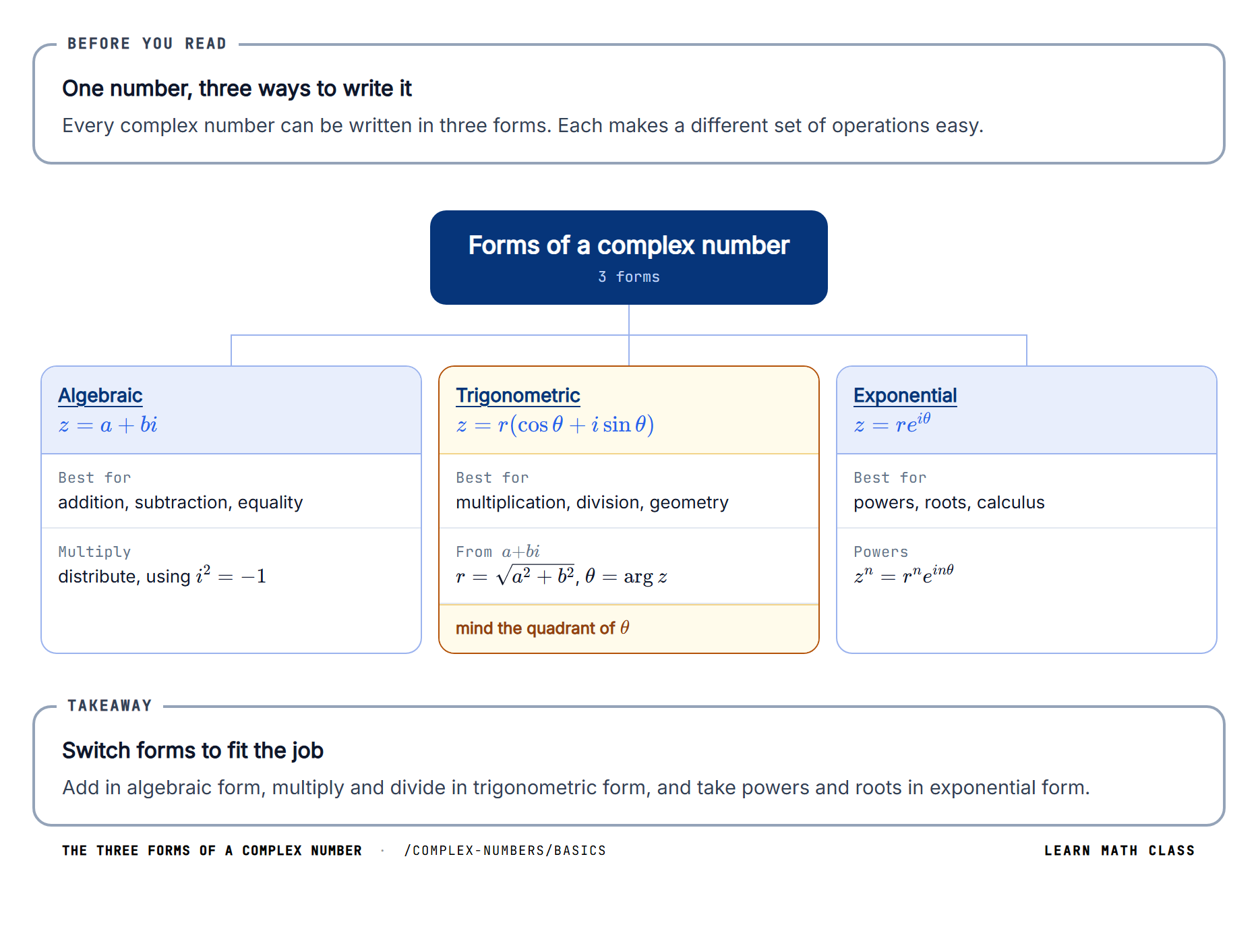
One number, three ways to write it
Every complex number can be written in three forms. Each makes a different set of operations easy.
Forms of a complex number3 forms
Algebraicz=a+biz = a + bi
Best foraddition, subtraction, equality
Multiplydistribute, using i2=−1i^2 = -1
Trigonometricz=r(cos⁡θ+isin⁡θ)z = r(\cos\theta + i\sin\theta)
Best formultiplication, division, geometry
From a+bia + bir=a2+b2r = \sqrt{a^2 + b^2}, θ=arg⁡z\theta = \arg z

mind the quadrant of θ\theta

Exponentialz=reiθz = re^{i\theta}
Best forpowers, roots, calculus
Powerszn=rneinθz^n = r^n e^{in\theta}
Takeaway
Switch forms to fit the job
Add in algebraic form, multiply and divide in trigonometric form, and take powers and roots in exponential form.
The three forms of a complex number·/complex-numbers/basicsLearn Math Class

Common Pitfalls

Six mistakes come up again and again in a first course on complex numbers. Five are marked where they happen in the sections above; ignoring the quadrant of the argument is the one that Trigonometric Representation already warns about. Here each is worked through in full, with the wrong and the right working side by side.

Dropping the sign of the imaginary part

When the imaginary term is subtracted, as in 4−5i4 - 5i, the minus sign is left behind and only the number after it is reported as the imaginary part.

Wrong working: 4−5i4 - 5i has Im(z)=5Im(z) = 5.

Right working: in standard form 4−5i=4+(−5)i4 - 5i = 4 + (-5)i, so Re(z)=4Re(z) = 4 and Im(z)=−5Im(z) = -5.

Why it happens: the minus looks like the operation between the two terms rather than part of the coefficient of ii.

How to check: plot the point. Im(z)=−5Im(z) = -5 puts 4−5i4 - 5i five units below the real axis, at (4,−5)(4, -5). An imaginary part of 55 would put it at (4,5)(4, 5), which is the conjugate 4+5i4 + 5i.

Subtracting only the real part

In z1−z2z_1 - z_2 the minus sign is applied to the real part of z2z_2 but not to its imaginary part, as if the brackets were not there.

Wrong working: (5+i)−(2−3i)=5+i−2−3i=3−2i(5 + i) - (2 - 3i) = 5 + i - 2 - 3i = 3 - 2i.

Right working: the minus sign changes the sign of both parts of z2z_2: (5+i)−(2−3i)=5+i−2+3i=3+4i(5 + i) - (2 - 3i) = 5 + i - 2 + 3i = 3 + 4i. Part by part, 5−2=35 - 2 = 3 and 1−(−3)=41 - (-3) = 4.

Why it happens: dropping brackets after a minus sign is a slip that already happens with real binomials, and a negative imaginary part turns it into a double negative.

How to check: add the second number back. (3+4i)+(2−3i)=5+i(3 + 4i) + (2 - 3i) = 5 + i returns the first number, while (3−2i)+(2−3i)=5−5i(3 - 2i) + (2 - 3i) = 5 - 5i does not.

Multiplying only the denominator

To make the denominator real, only the denominator is multiplied by its conjugate and the numerator is left as it was.

Wrong working: 3+2i1−4i=3+2i(1−4i)(1+4i)=3+2i17\frac{3 + 2i}{1 - 4i} = \frac{3 + 2i}{(1 - 4i)(1 + 4i)} = \frac{3 + 2i}{17}.

Right working: multiply the numerator and the denominator by 1+4i1 + 4i: (3+2i)(1+4i)(1−4i)(1+4i)=3+12i+2i+8i217=−5+14i17\frac{(3 + 2i)(1 + 4i)}{(1 - 4i)(1 + 4i)} = \frac{3 + 12i + 2i + 8i^2}{17} = \frac{-5 + 14i}{17}.

Why it happens: the step that makes the denominator real is remembered, while the reason it is allowed, multiplying by 1+4i1+4i=1\frac{1 + 4i}{1 + 4i} = 1, is forgotten.

How to check: multiply the answer by the original denominator. −5+14i17⋅(1−4i)=−5+20i+14i−56i217=51+34i17=3+2i\frac{-5 + 14i}{17} \cdot (1 - 4i) = \frac{-5 + 20i + 14i - 56i^2}{17} = \frac{51 + 34i}{17} = 3 + 2i, the original numerator.

Squaring the whole imaginary term

In ∣z∣=a2+b2|z| = \sqrt{a^2 + b^2}, the term bibi is put in place of bb, so the ii is squared along with it.

Wrong working: ∣3+4i∣=32+(4i)2=9−16=−7|3 + 4i| = \sqrt{3^2 + (4i)^2} = \sqrt{9 - 16} = \sqrt{-7}.

Right working: a=3a = 3 and b=4b = 4 are the two coordinates of the point (3,4)(3, 4), so ∣3+4i∣=32+42=25=5|3 + 4i| = \sqrt{3^2 + 4^2} = \sqrt{25} = 5.

Why it happens: the formula is read as "square each term of zz", and the imaginary term of 3+4i3 + 4i is 4i4i.

How to check: a modulus is a distance, so it is always a real number that is at least 00. A negative number under the root, or an answer containing ii, means the ii went into the formula.

Ignoring the quadrant

The argument is found from tan⁡θ=ba\tan\theta = \frac{b}{a} alone, and the calculator's arctangent is taken as the answer whatever the quadrant of zz.

Wrong working: for z=−1+iz = -1 + i, tan⁡θ=1−1=−1\tan\theta = \frac{1}{-1} = -1, so θ=arctan⁡(−1)=−45°\theta = \arctan(-1) = -45°.

Right working: −1+i-1 + i has a negative real part and a positive imaginary part, so it lies in the second quadrant. The angle there with tangent −1-1 is 180°−45°=135°180° - 45° = 135°, so arg⁡(−1+i)=135°\arg(-1 + i) = 135° and −1+i=2cis(135°)-1 + i = \sqrt{2}\text{cis}(135°).

Why it happens: the arctangent only returns angles between −90°-90° and 90°90°, so it cannot tell −1+i-1 + i from 1−i1 - i, which has the same tangent.

How to check: convert back. 2cis(−45°)=1−i\sqrt{2}\text{cis}(-45°) = 1 - i, which is not the starting number, while 2cis(135°)=−1+i\sqrt{2}\text{cis}(135°) = -1 + i.

Stopping at one root

An equation zn=wz^n = w is solved like a real equation, by taking a single nn-th root, and the other n−1n - 1 roots are never looked for.

Wrong working: z3=8z^3 = 8, so z=2z = 2, the real cube root of 88.

Right working: write 8=8cis(0°)8 = 8\text{cis}(0°). The roots are zk=2cis(360°k3)z_k = 2\text{cis}\left(\frac{360°k}{3}\right) for k=0,1,2k = 0, 1, 2: 22, 2cis(120°)=−1+3i2\text{cis}(120°) = -1 + \sqrt{3}i and 2cis(240°)=−1−3i2\text{cis}(240°) = -1 - \sqrt{3}i.

Why it happens: over the real numbers x3=8x^3 = 8 has only one solution, and that habit carries over.

How to check: an equation zn=wz^n = w with w≠0w \neq 0 has exactly nn roots, spaced 360°n\frac{360°}{n} apart on one circle. Cubing a candidate confirms it: (−1+3i)2=−2−23i(-1 + \sqrt{3}i)^2 = -2 - 2\sqrt{3}i, and (−2−23i)(−1+3i)=2−23i+23i+6=8(-2 - 2\sqrt{3}i)(-1 + \sqrt{3}i) = 2 - 2\sqrt{3}i + 2\sqrt{3}i + 6 = 8.

Complex Numbers FAQ

Why were complex numbers invented?

+
Not to solve x² = −1, despite the usual story. They were forced on mathematicians by cubic equations, where the formula for real solutions passed through square roots of negatives on the way to a real answer. The intermediate step could not be avoided, so the numbers had to be accepted as legitimate rather than dismissed.Read more →

Is every real number also a complex number?

+
Yes. A real number is a complex number whose imaginary part is zero, so 5 is the same object as 5 + 0i. The reals sit inside the complex numbers as the horizontal axis of the plane. Nothing about real arithmetic changes; complex numbers extend it rather than replacing it.Read more →

Is there a number system that multiplies triples the way complex numbers multiply pairs?

+
No, not one that keeps division. Any multiplication of triples a+bi+cja + bi + cj that distributes over sums and real multiples has two nonzero factors whose product is 00, so some numbers cannot be divided by. Hamilton searched for years before finding, in 1843, that four parts work: the quaternions. They keep division but give up commutativity, since their products depend on the order of the factors.Read more →

Is the complex plane the same as R2\mathbb{R}^2?

+
As a set of points, yes: a+bia + bi is the point (a,b)(a, b), and adding complex numbers is the same as adding vectors in R2\mathbb{R}^2. The difference is multiplication. R2\mathbb{R}^2 has no rule for multiplying two points, while C\mathbb{C} multiplies them using i2=−1i^2 = -1 and divides by any nonzero one. Writing C\mathbb{C} rather than R2\mathbb{R}^2 says that this multiplication is in use.Read more →

Can the square of a complex number be negative?

+
Yes. i2=−1i^2 = -1 and (2i)2=−4(2i)^2 = -4: every nonzero pure imaginary number has a negative real square. Most squares are not even real, for example (1+i)2=2i(1 + i)^2 = 2i. So the real-number rule z2≥0z^2 \geq 0 is false for z=iz = i and meaningless for z=1+iz = 1 + i, since complex numbers cannot be ordered. It is one of the habits from real variables that fail silently once zz is complex.Read more →