Visual Tools
Calculators
Tables
Mathematical Keyboard
Converters
Other Tools


Magnitude of a Vector


Measuring Length and Extracting Direction

Every nonzero vector carries two pieces of information: how long it is and which way it points. The norm isolates the first piece — it assigns a single non-negative number to each vector, measuring its length in a way that is consistent across any dimension. Once the norm is defined, distance between vectors follows immediately, and normalization provides a way to strip away length entirely, leaving behind a unit vector that encodes pure direction. The concepts on this page underpin nearly everything that follows in the section, from the angle formula in the dot product to the area interpretation of the cross product.


Magnitude in Two and Three Dimensions

In R2\mathbb{R}^2, the magnitude of a vector v=(v1,v2)\mathbf{v} = (v_1, v_2) is the length of the hypotenuse of the right triangle formed by its components:

v=v12+v22\|\mathbf{v}\| = \sqrt{v_1^2 + v_2^2}


This is a direct application of the Pythagorean theorem — the horizontal component v1v_1 and the vertical component v2v_2 form the two legs, and the vector itself is the hypotenuse.

In R3\mathbb{R}^3, the same reasoning applies in two stages. A vector v=(v1,v2,v3)\mathbf{v} = (v_1, v_2, v_3) can be decomposed into a component in the xyxy-plane with length v12+v22\sqrt{v_1^2 + v_2^2} and a vertical component v3v_3. Applying the Pythagorean theorem a second time gives:

v=v12+v22+v32\|\mathbf{v}\| = \sqrt{v_1^2 + v_2^2 + v_3^2}


The geometric intuition is the same in both cases: the magnitude is the straight-line distance from the tail of the vector to its tip. The only difference is the number of perpendicular components being combined.

The General Norm

The pattern from R2\mathbb{R}^2 and R3\mathbb{R}^3 extends without modification to any Rn\mathbb{R}^n. For a vector v=(v1,v2,,vn)\mathbf{v} = (v_1, v_2, \ldots, v_n):

v=v12+v22++vn2=i=1nvi2\|\mathbf{v}\| = \sqrt{v_1^2 + v_2^2 + \cdots + v_n^2} = \sqrt{\sum_{i=1}^{n} v_i^2}


This quantity is called the Euclidean norm, or equivalently the 2\ell^2 norm. The subscript distinguishes it from other ways of measuring vector size — the 1\ell^1 norm sums absolute values, the \ell^\infty norm takes the largest absolute component — but when "norm" appears without qualification in this section, it always refers to the Euclidean norm.

The double-bar notation v\|\mathbf{v}\| is standard for the norm. Single bars x|x| are reserved for the absolute value of a scalar. The distinction matters: magnitude is a property of vectors, absolute value is a property of numbers, and the notational separation keeps the two from being confused.

In dimensions beyond three, the formula cannot be visualized as a geometric length, but it retains the same algebraic role. It measures how far v\mathbf{v} sits from the origin in the coordinate system of Rn\mathbb{R}^n, generalizing the concept of length purely through algebra.

Properties of the Norm

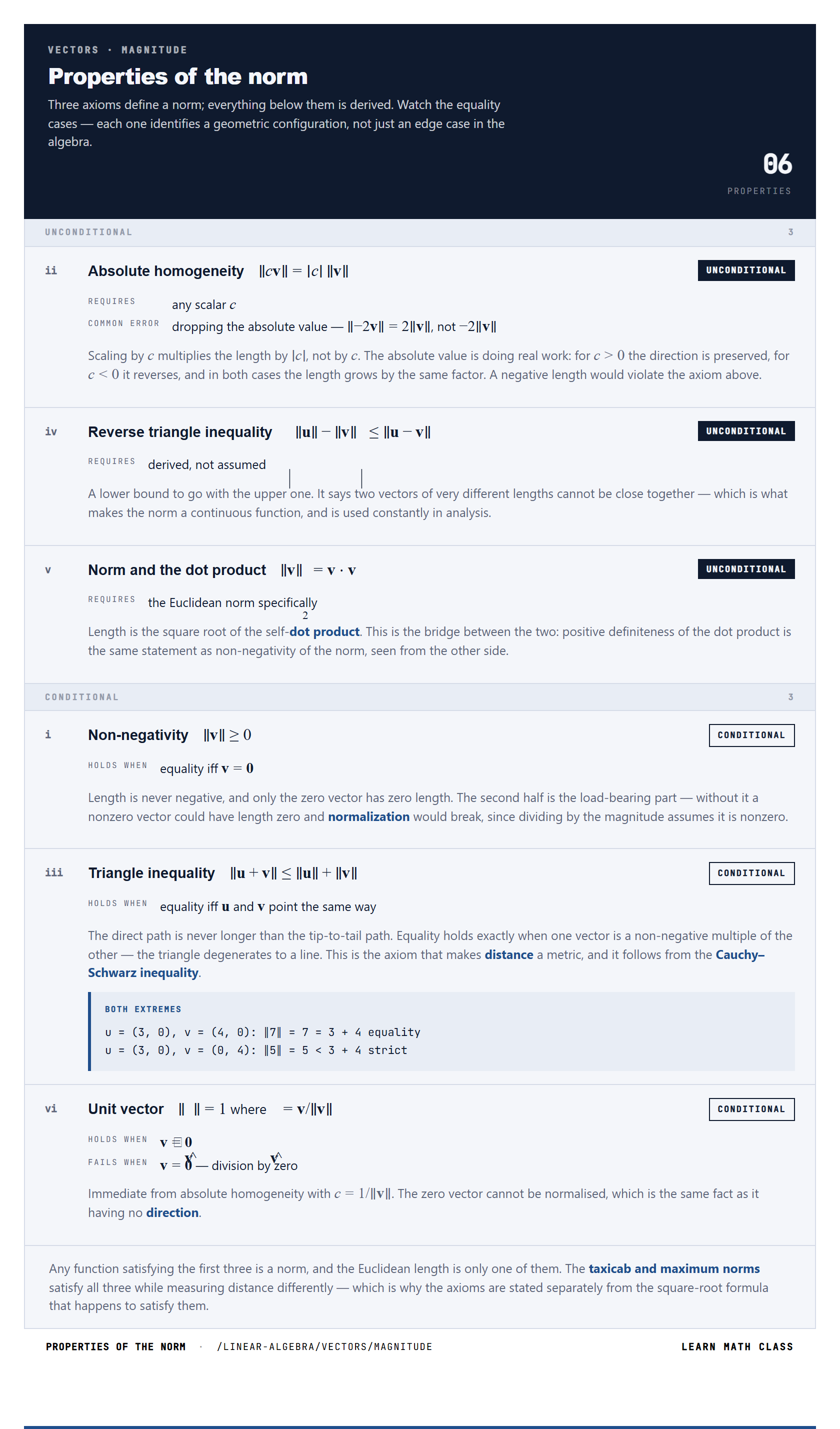
The Euclidean norm satisfies three properties that any reasonable notion of length should obey. Together, they are what make the norm a reliable measure of vector size.

Non-Negativity


v0,with equality if and only if v=0\|\mathbf{v}\| \geq 0, \quad \text{with equality if and only if } \mathbf{v} = \mathbf{0}


The sum of squared components is never negative, and its square root is zero only when every component is zero. Length is always non-negative, and the only vector with zero length is the zero vector itself.

Scaling


cv=cv\|c\mathbf{v}\| = |c|\,\|\mathbf{v}\|


Multiplying a vector by a scalar cc multiplies its length by c|c|. The absolute value is necessary because a negative scalar reverses the direction without producing a negative length. This property connects the norm directly to scalar multiplication: scaling a vector by cc does exactly what the geometric picture suggests — it stretches or compresses by c|c| and possibly flips.

Triangle Inequality


a+ba+b\|\mathbf{a} + \mathbf{b}\| \leq \|\mathbf{a}\| + \|\mathbf{b}\|


The length of a sum never exceeds the sum of the individual lengths. Geometrically, in the tip-to-tail picture of vector addition, the direct path from start to finish (the sum) is never longer than the path that follows both vectors end to end. Equality holds only when a\mathbf{a} and b\mathbf{b} point in the same direction — when the path is already straight. The triangle inequality is proved using the Cauchy–Schwarz inequality, which is developed on the dot product page.

Distance Between Vectors

The norm provides a natural way to measure how far apart two vectors are. The distance between a\mathbf{a} and b\mathbf{b} is defined as the norm of their difference:

d(a,b)=ab=(a1b1)2+(a2b2)2++(anbn)2d(\mathbf{a}, \mathbf{b}) = \|\mathbf{a} - \mathbf{b}\| = \sqrt{(a_1 - b_1)^2 + (a_2 - b_2)^2 + \cdots + (a_n - b_n)^2}


When a\mathbf{a} and b\mathbf{b} are interpreted as position vectors — arrows from the origin to points in space — this formula gives the straight-line distance between those points. In R2\mathbb{R}^2, it reduces to the familiar distance formula from coordinate geometry. In R3\mathbb{R}^3, it extends to three-dimensional Euclidean distance. In higher dimensions, the algebraic expression remains identical even though the geometry can no longer be drawn.

Distance inherits its behavior from the norm. It is always non-negative, equals zero only when the two vectors are identical, is symmetric (d(a,b)=d(b,a)d(\mathbf{a}, \mathbf{b}) = d(\mathbf{b}, \mathbf{a}), since ab=ba\|\mathbf{a} - \mathbf{b}\| = \|\mathbf{b} - \mathbf{a}\|), and satisfies its own triangle inequality: d(a,c)d(a,b)+d(b,c)d(\mathbf{a}, \mathbf{c}) \leq d(\mathbf{a}, \mathbf{b}) + d(\mathbf{b}, \mathbf{c}). These properties make the Euclidean distance a metric — a formal measure of separation on Rn\mathbb{R}^n.

Unit Vectors

A unit vector is a vector whose norm equals exactly 11:

u^=1\|\hat{\mathbf{u}}\| = 1


A unit vector retains all the directional information of the original vector while discarding any notion of scale. It answers the question "which way?" without saying "how far."

The standard basis vectors are the most immediate examples. In R3\mathbb{R}^3:

e1=(1,0,0),e2=(0,1,0),e3=(0,0,1)\mathbf{e}_1 = (1, 0, 0), \quad \mathbf{e}_2 = (0, 1, 0), \quad \mathbf{e}_3 = (0, 0, 1)


Each has exactly one component equal to 11 and the rest equal to 00, giving a norm of 11. These unit vectors point along the coordinate axes, and any vector can be decomposed as a linear combination of them: v=v1e1+v2e2+v3e3\mathbf{v} = v_1\mathbf{e}_1 + v_2\mathbf{e}_2 + v_3\mathbf{e}_3.

But unit vectors are not confined to the coordinate directions. Any direction in Rn\mathbb{R}^n has a corresponding unit vector. The vector (12,12)\left(\frac{1}{\sqrt{2}}, \frac{1}{\sqrt{2}}\right) is a unit vector in R2\mathbb{R}^2 pointing at 45°45° to both axes. The set of all unit vectors in R2\mathbb{R}^2 traces the unit circle; in R3\mathbb{R}^3, the unit sphere.

Normalization

Normalization is the process of converting any nonzero vector into the unit vector that shares its direction. Given v0\mathbf{v} \neq \mathbf{0}, the normalized form is:

v^=vv=1v(v1,v2,,vn)\hat{\mathbf{v}} = \frac{\mathbf{v}}{\|\mathbf{v}\|} = \frac{1}{\|\mathbf{v}\|}(v_1, v_2, \ldots, v_n)


This divides every component by the same positive scalar v\|\mathbf{v}\|, which is a special case of scalar multiplication by 1v\frac{1}{\|\mathbf{v}\|}. The scaling property of the norm guarantees that the result has magnitude 11:

vv=vv=1\left\|\frac{\mathbf{v}}{\|\mathbf{v}\|}\right\| = \frac{\|\mathbf{v}\|}{\|\mathbf{v}\|} = 1


Because the scalar 1v\frac{1}{\|\mathbf{v}\|} is positive, the direction of v\mathbf{v} is preserved — the normalized vector v^\hat{\mathbf{v}} points exactly the same way as v\mathbf{v}, just with unit length.

The zero vector cannot be normalized. It has 0=0\|\mathbf{0}\| = 0, and dividing by zero is undefined. This is consistent with the geometric fact that the zero vector carries no directional information — there is no "way" it points, so extracting a direction from it is impossible.

Normalization appears throughout the rest of this section. The angle formula on the dot product page involves the quantity abab\frac{\mathbf{a} \cdot \mathbf{b}}{\|\mathbf{a}\|\|\mathbf{b}\|}, which is the dot product of the two normalized vectors a^b^\hat{\mathbf{a}} \cdot \hat{\mathbf{b}}. Orthogonal projection decomposes a vector relative to a direction, and that direction is specified most cleanly through a unit vector. Whenever a formula isolates the directional component of a vector, normalization is doing the work underneath.