1Adding counts of sequential choices
An outcome is built in stages, one choice at each stage, but the counts of the stages are added as if they were alternatives. The sum counts the options at the stages, not the ways to combine them.
Wrong turnError hereAn outfit is one of 5 shirts and one of 3 pairs of trousers, so there are 5+3=8 outfits.
Right pathEvery shirt can be worn with every pair of trousers. The multiplication rule gives 5⋅3=15 outfits. Why it happensBoth rules start from the same numbers, and "5 shirts and 3 pairs of trousers" reads like a list of things to total. The addition rule fits only when exactly one option is picked from one of the groups.
How to checkList the outcomes for a single shirt. It already gives 3 outfits, one with each pair of trousers, so 5 shirts give 5 groups of 3. 2Dropping the triple intersection
With three sets, the pairwise intersections are subtracted and the calculation stops there. Elements that lie in all three sets were added three times and subtracted three times, so they are no longer counted at all.
Wrong turnError hereFor the numbers 1 to 30 divisible by 2, 3 or 5, ∣A∣=15, ∣B∣=10, ∣C∣=6, ∣A∩B∣=5, ∣A∩C∣=3 and ∣B∩C∣=2, so the count is 15+10+6−5−3−2=21.
Right pathThe triple intersection holds the multiples of 30, so ∣A∩B∩C∣=1 and ∣A∪B∪C∣=21+1=22. Why it happensThe two-set formula ends with a subtraction, and the three-set version is remembered as "add the sets, subtract the overlaps" without its last term.
How to checkCount the complement. The numbers from 1 to 30 divisible by none of 2, 3 and 5 are 1,7,11,13,17,19,23,29. There are 8 of them, and 30−8=22. 3Using a permutation for a selection
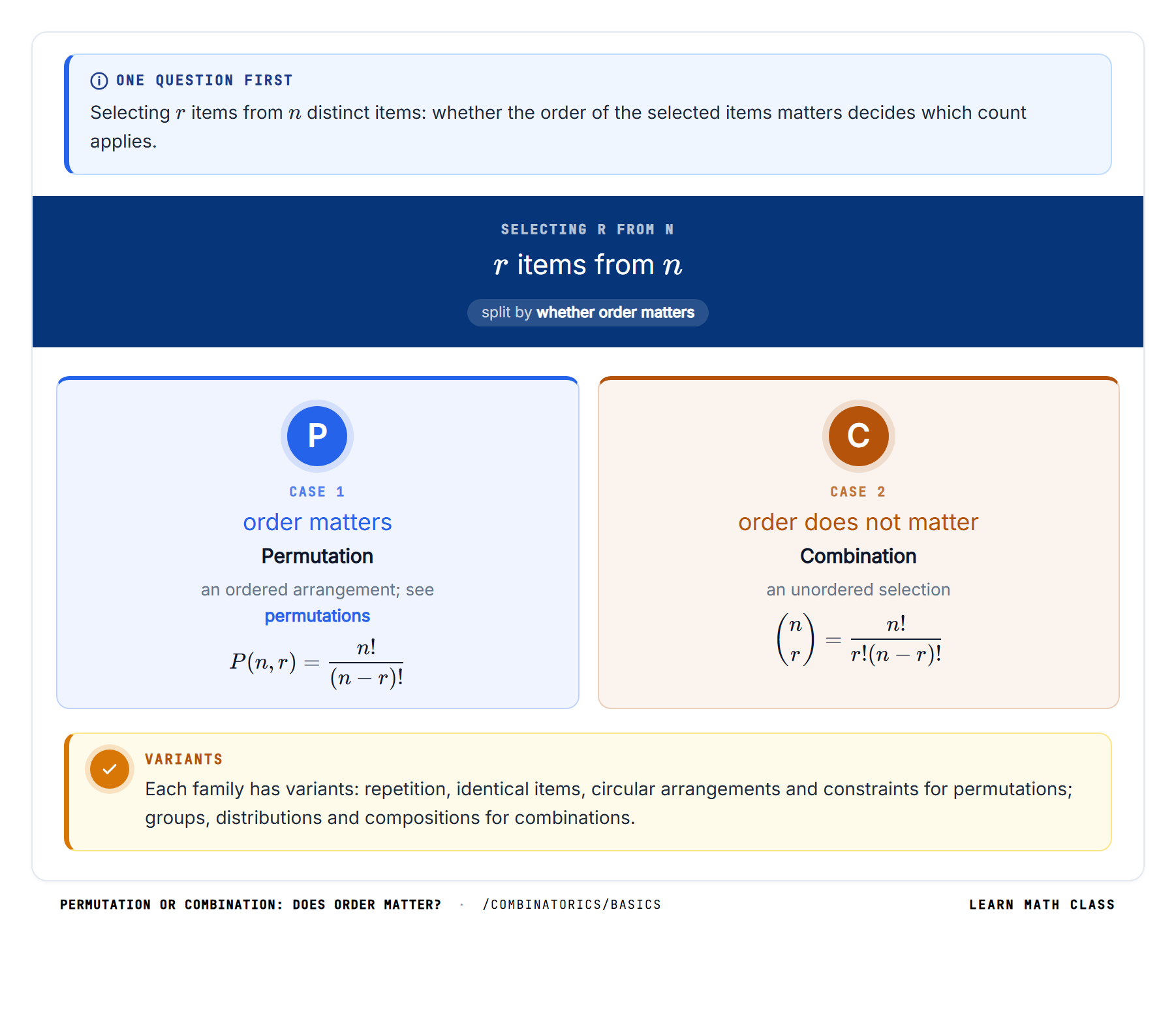
A problem that asks only which items are chosen is counted with P(n,r), the formula for ordered arrangements. Each selection is then counted once for every order of its items. Wrong turnError hereA committee of 3 from 10 people is counted as P(10,3)=10⋅9⋅8=720.
Right pathA committee has no first, second or third member, so order does not matter: (310)=3!720=6720=120. Why it happensPicking the members one after another feels like a sequence of choices, and the multiplication rule naturally produces 10⋅9⋅8. How to checkSwap two chosen items. If Ann, Ben, Cat and Cat, Ben, Ann describe the same committee, order does not matter and the ordered count must be divided by r!. 4Swapping base and exponent
In a power formula such as rn for a distribution into cells, the number of items and the number of cells trade places. The count then answers a different question. Start3 distinct letters are dropped into 4 mailboxes, and a mailbox may stay empty. Wrong turnError hereThe count is given as 34=81.
Right pathEach of the 3 letters chooses one of the 4 mailboxes, so the count is 4⋅4⋅4=43=64. Why it happensThe two power formulas on the page, nr and rn, look alike, and the letters n and r stand for different things in the two scenarios. How to checkTry a single letter. It can go into any of the 4 mailboxes, which 41=4 gives and 14=1 does not. 5Forgetting the power on b
A term of the binomial expansion is written with its coefficient (kn) and the power of the variable, but the number in the binomial is not raised to its power. Wrong turnError hereThe x2 term of (x+2)4 has k=2, and it is written as (24)x2⋅2=6⋅2x2=12x2.
Right pathThe term is (24)x2⋅22=6⋅4x2=24x2. The full expansion is (x+2)4=x4+8x3+24x2+32x+16. Why it happensIn (a+b)n with letters, bk looks like bookkeeping for the variables, and when b is a number its power is easy to lose. How to checkSet x=1. The expansion must equal (1+2)4=81, and 1+8+24+32+16=81; with 12x2 in place of 24x2 the sum is only 69.