Visual Tools
Calculators
Tables
Mathematical Keyboard
Converters
Other Tools


Continuity of Limits


Where Limits Meet Function Values


A function is continuous at a point when its limit there equals its actual value. No gap, no jump, no missing point—the function does exactly what its nearby behavior predicts.

This simple requirement has profound consequences. Continuous functions behave predictably: you can evaluate limits by direct substitution, the graph has no breaks, and values change gradually rather than abruptly.

Discontinuities occur when something fails. The function might be undefined at the point, the limit might not exist, or the limit might exist but differ from the function value. Classifying what goes wrong reveals the nature of the break and whether it can be repaired.


The Intuitive Idea


A continuous function has no breaks in its graph. You can trace the curve without lifting your pen. The function value at each point matches what the surrounding values predict.

Intuitively, small changes in input produce small changes in output. There are no surprises—no sudden jumps, no missing points, no explosions to infinity.

This matches everyday experience. Temperature varies continuously throughout the day. Position changes continuously as you walk. Discontinuities—sudden jumps or gaps—signal something unusual: a switch being flipped, a boundary being crossed.
The Formal Definition


A function ff is continuous at x=ax = a if three conditions hold:

1. f(a)f(a) is defined — the function has a value at aa

2. limxaf(x)\lim_{x \to a} f(x) exists — the two-sided limit exists

3. limxaf(x)=f(a)\lim_{x \to a} f(x) = f(a) — the limit equals the function value

All three conditions must hold. The single equation

limxaf(x)=f(a)\lim_{x \to a} f(x) = f(a)


encapsulates all three: the right side requires f(a)f(a) to exist, the left side requires the limit to exist, and the equality requires them to match.

Continuity on Intervals


    A function is continuous on an open interval (a,b)(a, b) if it is continuous at every point in that interval.

    For closed intervals [a,b][a, b], the definition adjusts at endpoints where only one direction of approach is available:

  • (a,b)(a, b)
  • aa: limxa+f(x)=f(a)\lim_{x \to a^+} f(x) = f(a)
  • bb: limxbf(x)=f(b)\lim_{x \to b^-} f(x) = f(b)

  • One-sided continuity handles the boundaries where the domain restricts approach to a single direction.

Types of Discontinuities


Discontinuities are classified by which condition fails and how.

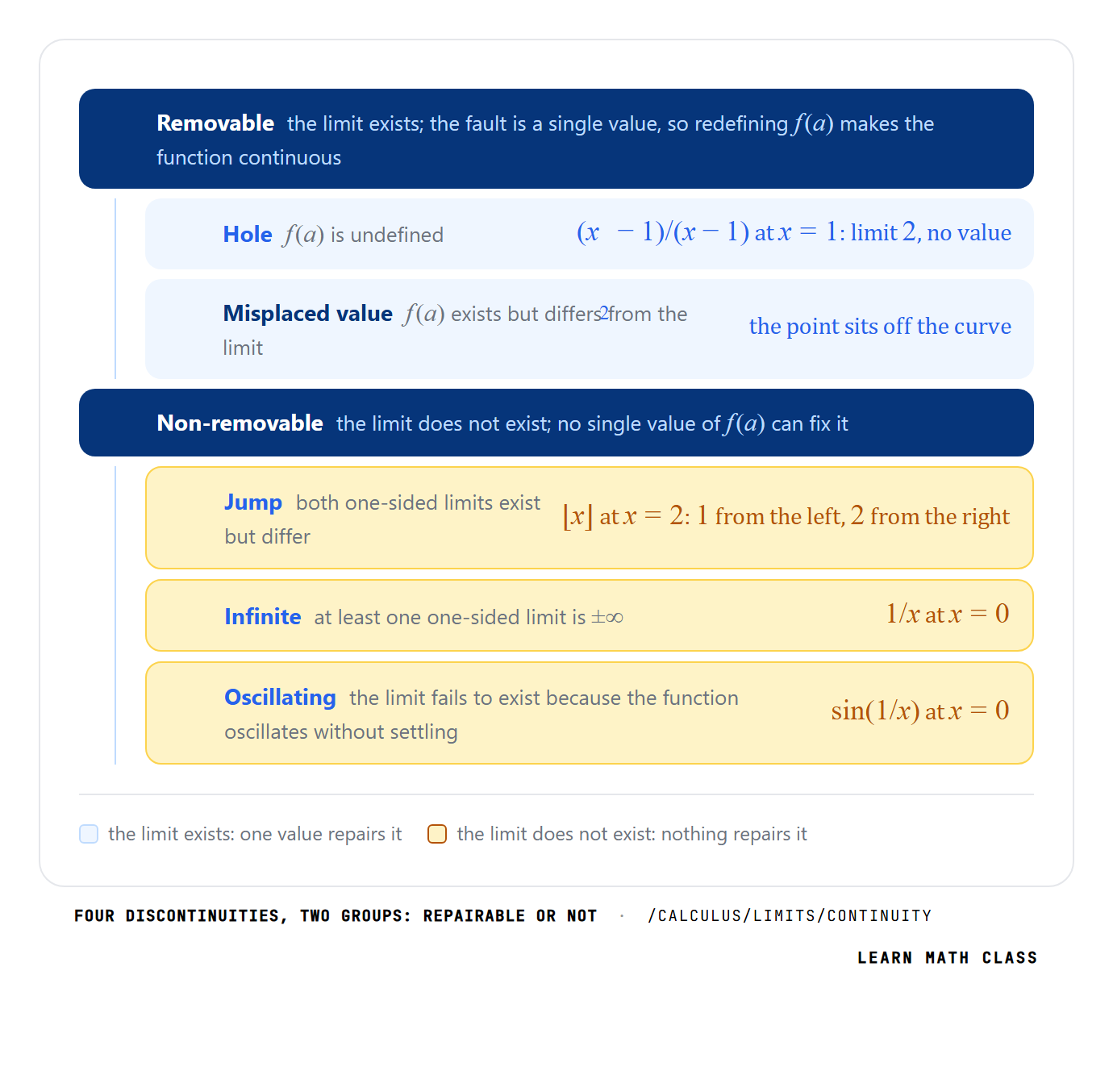
Removable discontinuity: The limit exists, but f(a)f(a) is undefined or f(a)limxaf(x)f(a) \neq \lim_{x \to a} f(x)

Jump discontinuity: Both one-sided limits exist but differ

Infinite discontinuity: At least one one-sided limit is ±\pm\infty

Oscillating discontinuity: The limit fails to exist due to oscillation

Each type reveals different information about the function's behavior and determines whether the discontinuity can be "fixed."

Removable Discontinuity


A removable discontinuity occurs when the limit exists but differs from the function value (or the function is undefined).

Consider:

f(x)=x21x1f(x) = \frac{x^2 - 1}{x - 1}


For x1x \neq 1, this simplifies to x+1x + 1. The limit as x1x \to 1 is 22. But f(1)f(1) is undefined—division by zero.

The graph shows a hole at (1,2)(1, 2). The discontinuity is removable because redefining f(1)=2f(1) = 2 fills the hole and makes the function continuous.

Removable discontinuities are "accidents" that can be repaired with a single point adjustment.

Jump Discontinuity


A jump discontinuity occurs when both one-sided limits exist but are unequal:

limxaf(x)limxa+f(x)\lim_{x \to a^-} f(x) \neq \lim_{x \to a^+} f(x)


The function "jumps" from one value to another at x=ax = a.

The floor function x\lfloor x \rfloor jumps at every integer. At x=2x = 2:

limx2x=1limx2+x=2\lim_{x \to 2^-} \lfloor x \rfloor = 1 \qquad \lim_{x \to 2^+} \lfloor x \rfloor = 2


No single value of f(2)f(2) can equal both one-sided limits. The discontinuity cannot be removed—the gap is intrinsic to the function's definition.

Infinite Discontinuity


An infinite discontinuity occurs when the function blows up—at least one one-sided limit equals ±\pm\infty.

For f(x)=1xf(x) = \dfrac{1}{x} at x=0x = 0:

limx01x=limx0+1x=+\lim_{x \to 0^-} \frac{1}{x} = -\infty \qquad \lim_{x \to 0^+} \frac{1}{x} = +\infty


The graph has a vertical asymptote at x=0x = 0. No finite value can serve as f(0)f(0) because the function escapes to infinity from both sides.

Infinite discontinuities mark points where the function is fundamentally unbounded.

Oscillating Discontinuity


An oscillating discontinuity occurs when the function oscillates without settling, preventing the limit from existing.

The classic example is f(x)=sin(1/x)f(x) = \sin(1/x) at x=0x = 0. As x0x \to 0, the argument 1/x±1/x \to \pm\infty, causing sine to oscillate between 1-1 and 11 infinitely often.

No single value LL works because the function repeatedly swings away from any candidate. The limit does not exist—not because of a jump or blowup, but because of uncontrolled oscillation.

Continuous Functions — The Standard Library


    Many familiar functions are continuous on their entire domains:

  • Polynomials: continuous everywhere

  • Rational functions: continuous except where the denominator is zero

  • Trigonometric functions: sinx\sin x, cosx\cos x continuous everywhere; tanx\tan x, secx\sec x, etc. continuous where defined

  • Exponential functions: exe^x, axa^x continuous everywhere

  • Logarithmic functions: lnx\ln x, logax\log_a x continuous on (0,)(0, \infty)

  • Root functions: xn\sqrt[n]{x} continuous on their domains

  • For these functions, evaluating limits reduces to direct substitution.

Combinations of Continuous Functions


Continuity is preserved under standard operations. If ff and gg are continuous at aa, then so are:

f+gfgfgfg  (if g(a)0)f + g \qquad f - g \qquad f \cdot g \qquad \frac{f}{g} \;(\text{if } g(a) \neq 0)


Compositions also preserve continuity: if gg is continuous at aa and ff is continuous at g(a)g(a), then fgf \circ g is continuous at aa.

These limit rules carry over directly to continuity, since continuity is defined in terms of limits.

The Intermediate Value Theorem (IVT)


If ff is continuous on [a,b][a, b] and kk is any value between f(a)f(a) and f(b)f(b), then f(c)=kf(c) = k for some cc in (a,b)(a, b).

f(a)<k<f(b)f(c)=k for some c(a,b)f(a) < k < f(b) \quad \Longrightarrow \quad f(c) = k \text{ for some } c \in (a, b)


Continuous functions hit every intermediate value—no skipping. The graph cannot jump from f(a)f(a) to f(b)f(b) without passing through every height in between.

This theorem guarantees existence. It says a cc exists but does not tell you where or whether it is unique.

Using IVT to Locate Roots


A sign change guarantees a root. If ff is continuous on [a,b][a, b] with:

f(a)<0andf(b)>0f(a) < 0 \quad \text{and} \quad f(b) > 0


then f(c)=0f(c) = 0 for some c(a,b)c \in (a, b).

Example: Show that x3x1=0x^3 - x - 1 = 0 has a solution in (1,2)(1, 2).

Let f(x)=x3x1f(x) = x^3 - x - 1.

f(1)=111=1<0f(1) = 1 - 1 - 1 = -1 < 0

f(2)=821=5>0f(2) = 8 - 2 - 1 = 5 > 0


Since ff is continuous and changes sign, IVT guarantees a root between 11 and 22.

The bisection method refines this: repeatedly halve the interval, keeping the half where the sign change occurs, to approximate the root to any desired precision.