Infinity enters limits in two distinct ways. When we write x→∞, we ask what happens to a function as its input grows without bound. When we write f(x)→∞, we describe a function whose output grows without bound as the input approaches some value.
These are different phenomena requiring different analyses. Limits at infinity reveal end behavior—how a function settles (or doesn't) as x moves far from the origin. Infinite limits reveal explosive behavior—where a function blows up as x approaches a finite point.
Both concepts connect to asymptotes. Horizontal asymptotes arise from finite limits at infinity. Vertical asymptotes arise from infinite limits at finite points. Together they sketch a function's large-scale structure.
Two Distinct Concepts
The notation distinguishes two cases:
Limits at infinity: The input grows without bound.
x→∞limf(x)x→−∞limf(x)
Infinite limits: The output grows without bound.
x→alimf(x)=∞x→alimf(x)=−∞
In the first case, x escapes to infinity while we track where f(x) goes. In the second case, x approaches a finite value a while f(x) escapes to infinity.
Both use the infinity symbol, but in opposite roles.
Limits at Infinity — Horizontal Behavior
The limit
x→∞limf(x)=L
means f(x) approaches L as x increases without bound. No matter how close to L you demand, sufficiently large x will place f(x) within that tolerance.
Similarly:
x→−∞limf(x)=M
means f(x) approaches M as x decreases without bound.
These limits describe end behavior—the function's long-run tendency. The limit may be a finite number, ∞, −∞, or may not exist (if the function oscillates).
Horizontal Asymptotes
If limx→∞f(x)=L where L is finite, the line y=L is a horizontal asymptote. The graph approaches this line as x→∞.
A function can have:
x→∞ and x→−∞)
For example:
f(x)=x−32x+1
x→∞limf(x)=2x→−∞limf(x)=2
The line y=2 is a horizontal asymptote in both directions.
Evaluating Limits at Infinity — Rational Functions
For rational functions, divide numerator and denominator by the highest power of x in the denominator.
x→∞lim2x2−73x2+5x−1
Divide by x2:
=x→∞lim2−x273+x5−x21=2−03+0−0=23
Terms with x in the denominator vanish as x→∞. Only the leading coefficients survive.
Dominant Term Analysis
As x→∞, the highest-degree terms control behavior. Lower-degree terms become negligible.
For q(x)p(x) where p has degree m and q has degree n:
Case $m < n$: The limit is 0. The denominator grows faster.
x→∞limx3−2x+1=0
Case $m = n$: The limit is the ratio of leading coefficients.
x→∞lim2x2+54x2+x=24=2
Case $m > n$: The limit is ±∞. The numerator grows faster.
x→∞limx+1x3=∞
Growth Rates — The Hierarchy
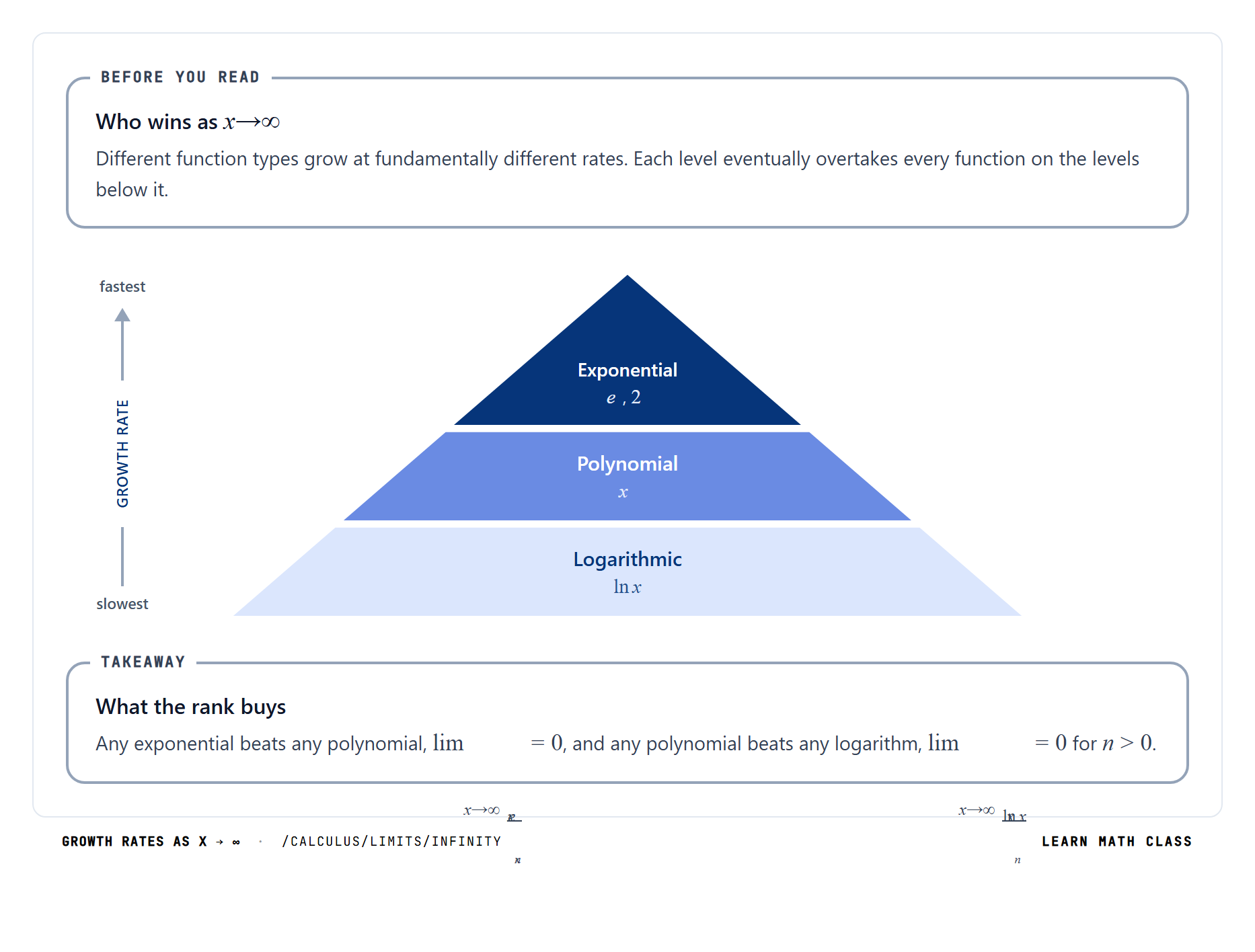
Different function types grow at fundamentally different rates as x→∞:
logarithmic≪polynomial≪exponential
Any exponential eventually overtakes any polynomial:
x→∞limexxn=0for any n
Any polynomial eventually overtakes any logarithm:
x→∞limxnlnx=0for any n>0
These special limits determine which terms dominate in mixed expressions.
Infinite Limits — Vertical Behavior
The notation
x→alimf(x)=∞
means f(x) grows without bound as x approaches a. For any large number M, values of x sufficiently close to a make f(x)>M.
Similarly:
x→alimf(x)=−∞
means f(x) becomes arbitrarily negative.
These are not limits in the usual sense—∞ is not a number. The notation describes unbounded behavior, not convergence to a value.
Vertical Asymptotes
If any of the following hold:
x→a+limf(x)=±∞x→a−limf(x)=±∞
then the line x=a is a vertical asymptote. The graph shoots up or down near x=a.
Vertical asymptotes typically occur where the denominator of a rational function equals zero while the numerator does not.
For f(x)=x−21, the denominator vanishes at x=2. The line x=2 is a vertical asymptote.
Sign Analysis for Infinite Limits
To determine whether a limit is +∞ or −∞, analyze the sign of the expression near the point.
x→2+limx−21
For x slightly greater than 2: x−2>0 (small positive), so x−21 is large positive.
x→2+limx−21=+∞
For x slightly less than 2: x−2<0 (small negative), so x−21 is large negative.
x→2−limx−21=−∞
One-Sided Infinite Limits
The one-sided limits from the left and right may both be infinite but with opposite signs.
For f(x)=x−21:
x→2−limf(x)=−∞x→2+limf(x)=+∞
The two-sided limit does not exist because the sides disagree—even though both are "infinite."
For f(x)=(x−2)21:
x→2−limf(x)=+∞x→2+limf(x)=+∞
Both sides agree, so we write limx→2f(x)=+∞.
Limits of Exponentials at Infinity
The exponential function ex exhibits contrasting behavior in opposite directions:
x→∞limex=∞
x→−∞limex=0
As x→∞, exponential growth is unbounded. As x→−∞, the function decays toward zero.
For e−x, the behavior reverses:
x→∞lime−x=0
x→−∞lime−x=∞
The horizontal asymptote y=0 appears in the direction where the exponent goes to −∞.
Limits of Logarithms Toward Zero and Infinity
The natural logarithm is defined only for x>0. Its behavior at the boundaries:
x→∞limlnx=∞
The logarithm grows without bound, but slowly—slower than any positive power of x.
x→0+limlnx=−∞
As x approaches zero from the right, lnx plunges to −∞. The line x=0 is a vertical asymptote for lnx.
The one-sided notation is essential: lnx is undefined for x≤0, so no left-hand limit exists at x=0.