In many probability settings, two numerical quantities are recorded from the same experiment or observation. Describing each quantity on its own does not explain how they behave in relation to one another.
Covariance is the concept used to describe this relationship. It focuses on how the numerical values of two random variables compare across repeated observations, relative to their typical levels.
This idea becomes essential whenever probability models involve more than one random variable.
Variance describes how a single random variable is distributed around its typical value. It captures variability, but only for one quantity at a time.
In many applications, two quantities are observed together in each trial or measurement. Treating them independently ignores how their values are related across the same observations.
Covariance extends the idea of variability to pairs of random variables by focusing on their joint behavior rather than on each variable in isolation.
What Covariance Describes
For each random variable, values fluctuate around an average level. Covariance examines how the positions of two variables relative to their own averages compare across the same observations.
If both variables tend to be above their averages at the same time, or below them at the same time, the covariance reflects this alignment. If one variable tends to be above its average while the other is below, the covariance reflects an opposing pattern.
In this way, covariance summarizes the directional relationship between the deviations of two random variable.
Formally, covariance is the average product of the two deviations from the means:
Twelve paired observations, with dashed lines at the mean of x and the mean of y. Each point’s deviation from the two means is either the same sign (both above or both below: blue) or opposite signs (amber). Covariance averages the products of the two deviations; here the blue points dominate, so the products are mostly positive and the covariance is positive: high x tends to come with high y.
If the amber points dominated instead, the covariance would be negative.
Interpreting the Sign of Covariance
The value of covariance indicates the direction of the relationship between two random variables, not its strength.
A positive covariance means that higher-than-average values of one variable tend to occur with higher-than-average values of the other. A negative covariance means that higher-than-average values of one variable tend to occur with lower-than-average values of the other.
A covariance close to zero indicates no consistent linear relationship in how the two variables deviate from their averages.
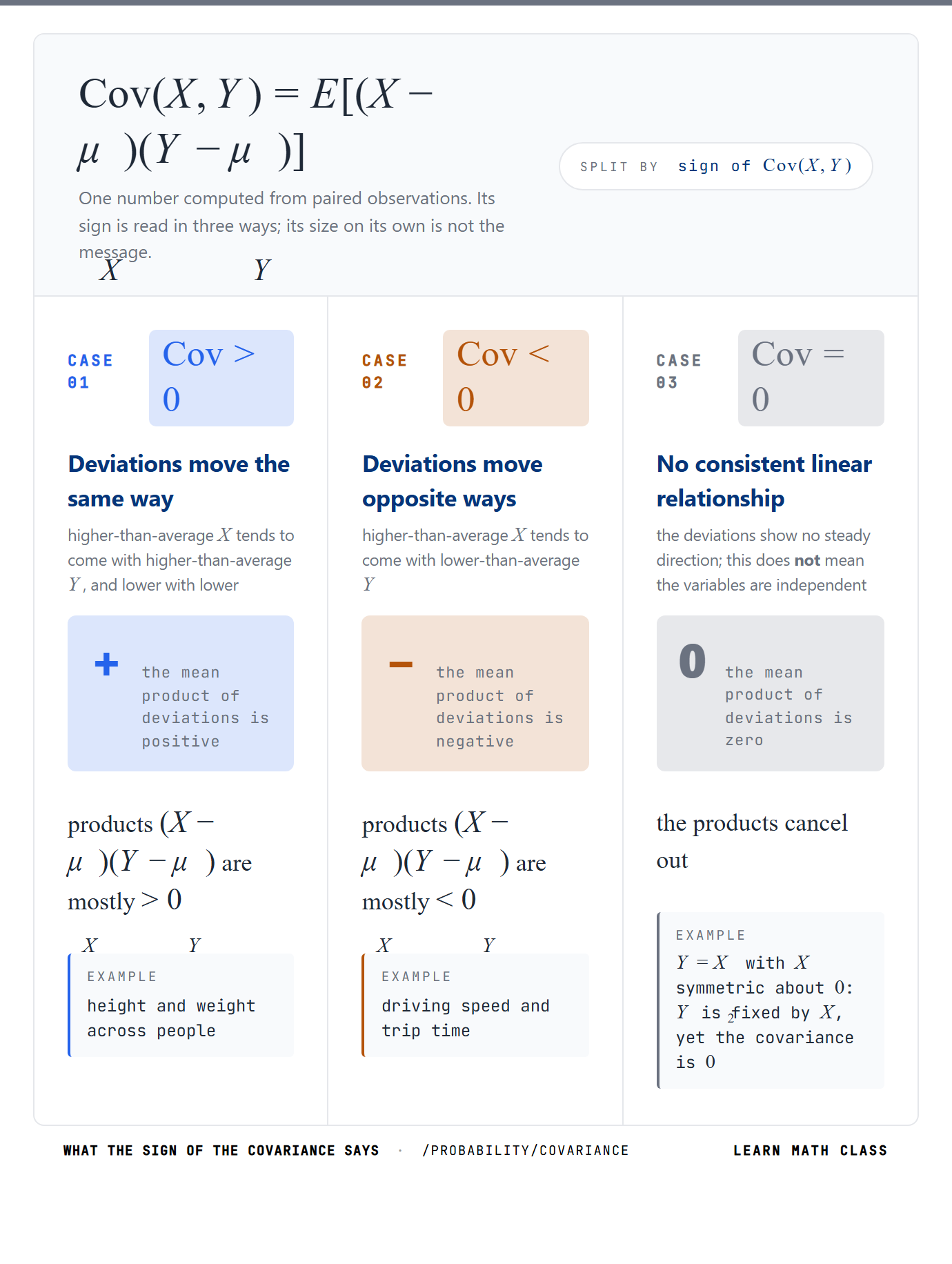
The sign is the whole message: as the section says, covariance reports direction, not strength. Two of the pairs listed later on this page, height and weight and study time and exam score, tend to deviate the same way, so their covariance is positive. A pair that deviates in opposite ways, such as driving speed and the time a trip takes, has a negative covariance.
Covariance averages the products of the two deviations from the means. Only its sign is read here: it reports the direction of the linear relationship, not its strength.
Cov(X,Y)=E[(X−μX)(Y−μY)]
split by sign of Cov(X,Y)
One number computed from paired observations. Its sign is read in three ways; its size on its own is not the message.
+
Case 01
Cov>0
Deviations move the same way
the mean product of deviations is positive
higher-than-average X tends to come with higher-than-average Y, and lower with lower
products (X−μX)(Y−μY) are mostly >0
e.g.height and weight across people
−
Case 02
Cov<0
Deviations move opposite ways
the mean product of deviations is negative
higher-than-average X tends to come with lower-than-average Y
products (X−μX)(Y−μY) are mostly <0
e.g.driving speed and trip time
0
Case 03
Cov=0
No consistent linear relationship
the mean product of deviations is zero
the deviations show no steady direction; this does not mean the variables are independent
the products cancel out
e.g.Y=X2 with X symmetric about 0: Y is fixed by X, yet the covariance is 0
Takeaway
To compare strength across different pairs, divide by σXσY: the correlation ρXY strips the units away and always lies in [−1,1].
The third card is the one to read twice. A covariance of zero rules out a consistent linear tendency and nothing more; the next section shows that two variables can depend on each other completely and still have covariance exactly zero.
Covariance and Independence
THEOREM
If two random variables are independent, their joint behavior separates into two
unrelated components. As a result, their covariance evaluates to zero.
The converse does not hold. A covariance value of zero does not rule out dependence. Two variables may exhibit structured relationships that covariance does not capture.
Covariance therefore reflects only one limited aspect of how random variables may be related.
Dependent, with zero covariance
Let X take the values −2, −1, 0, 1, 2 with equal probability and set Y = X². Knowing X fixes Y completely. Yet the points on the left of the parabola mirror those on the right: every positive product of deviations is matched by a negative one, so Cov(X, Y) = E[X³] − E[X]E[X²] = 0. Covariance measures linear tendency only, and a symmetric curve has none.
So independence implies zero covariance, but zero covariance does not imply independence.
Why Covariance Is Important
Covariance provides a way to describe how two random variables are related beyond their individual behavior. It captures information that variance alone cannot express.
This concept plays a central role in many areas of probability and statistics, including the study of joint distributions, linear relationships, and multivariate models. It is also a key component in formulas involving sums of random variables.
Understanding covariance is essential before introducing correlation, covariance matrices, and more advanced multivariate concepts.
Common Examples of Covariance
Covariance arises whenever two numerical quantities are recorded from the same set of observations.
Examples include pairs such as height and weight, study time and exam score, daily temperature and energy usage, or returns of two financial assets. In each case, the interest is not only in the individual values, but in how the two quantities are related across the same observations.
These situations motivate the use of covariance as a basic descriptive tool for joint behavior.
Covariance Notation
Notation
Covariance Notation
A two-argument operator, its subscripted Greek shorthand, and the normalized cousin that strips the units away. All are catalogued among the probability symbols.
A two-argument operator: it consumes a pair of random variables and returns one number measuring how they move together — E[(X−μX)(Y−μY)]. Print sets the name upright, like Var and E.
CasesThe arguments commute — Cov(X,Y)=Cov(Y,X) — and feeding the same variable twice collapses it to variance: Cov(X,X)=Var(X), which is why the two operators share a family.
Do not confuseA statement about dependence. Cov(X,Y)=0 means uncorrelated, not independent — the two coincide only in special cases, as Covariance and Independence above explains; independence forces zero covariance, never the reverse.
σXY
sigma X Y — the covariance
The parameter-side spelling, matching the σ2 of variance: a double subscript names the pair. With this convention σXX is just σX2, and the whole family collects into a covariance matrix.
CasesMatrix work makes the subscripts indices — σij for the covariance of the i-th and j-th variables — the coordinate-slot subscript job applied to a pair rather than a position.
Do not confuseA product of sigmas. σXY is one symbol with a two-letter subscript, not σX⋅σY — that product appears in the denominator of the correlation below, which is a different quantity entirely.
ρXY
rho — the correlation coefficient
Covariance with the units divided out: ρ=σXσYCov(X,Y), which forces the value into [−1,1] and makes different variable pairs comparable — something raw covariance, carrying the product of two units, can never be.
Also writtenCorr(X,Y) — the spelled-out operator, preferred where ρ is already taken; sample estimates switch to Latin r, following the population-versus-estimate convention that pairs μ with xˉ.
Do not confuseA measure of any relationship. ρ detects linear association only — a perfect parabola can have ρ=0 while the variables determine each other completely; the sign carries direction, the magnitude carries linear strength, and neither carries causation.
Covariance serves as the foundation for more structured ways of describing relationships between multiple random variables.
It leads directly to correlation, covariance matrices, and the study of joint distributions. These tools extend the ideas introduced here to broader multivariate settings and applications.
Correlation rescales covariance by the two standard deviations, and its value always stays within a fixed range:
The table below collects covariance into a single reference card — its definition, the symmetry and self-covariance identities, the sign interpretation (positive, negative, zero), the one-way relationship with independence, what covariance does and does not capture, common examples of paired quantities, and the concepts it leads into.
basis for multivariate models, linear regression, and portfolio theory
Covariance FAQ
Does zero covariance mean independence?
+
No — the implication runs one way only. Independence forces covariance to zero, but zero covariance does not force independence. Covariance detects linear association, so a relationship with no linear component slips past it: for a perfect parabola the variables determine each other completely, yet the covariance can be exactly zero. Zero covariance means uncorrelated, which is strictly weaker.Read more →
What is the difference between covariance and correlation?
+
Units. Covariance carries the product of both variables' units, so its size means nothing on its own — you cannot tell a large covariance from a small one without knowing the scales. Correlation divides that out, forcing the value into [−1, 1] and making different pairs comparable. Both detect linear association only, and neither carries causation.Read more →
Why does Cov(X, X) equal the variance?
+
Because feeding the same variable into both slots reproduces the variance definition. Cov(X, Y) is E[(X − μ_X)(Y − μ_Y)]; set Y = X and the two factors become identical, giving E[(X − μ_X)²], which is Var(X). Variance is the special case of covariance where a variable is paired with itself, which is why the two operators share a family.Read more →
Is σ_XY the same as σ_X times σ_Y?
+
No. σ_XY is a single symbol with a two-letter subscript naming a pair — it is the covariance, not a product. The product σ_X σ_Y is a different quantity, and it appears in the denominator of the correlation coefficient. Reading the subscript as multiplication gives something with the wrong units and the wrong value.Read more →