Visual Tools
Calculators
Tables
Mathematical Keyboard
Converters
Other Tools


Special Interals


Formulas Worth Knowing


Certain integrals appear so frequently that recognizing them on sight saves considerable effort. These standard forms serve as endpoints—the targets that techniques aim to reach.

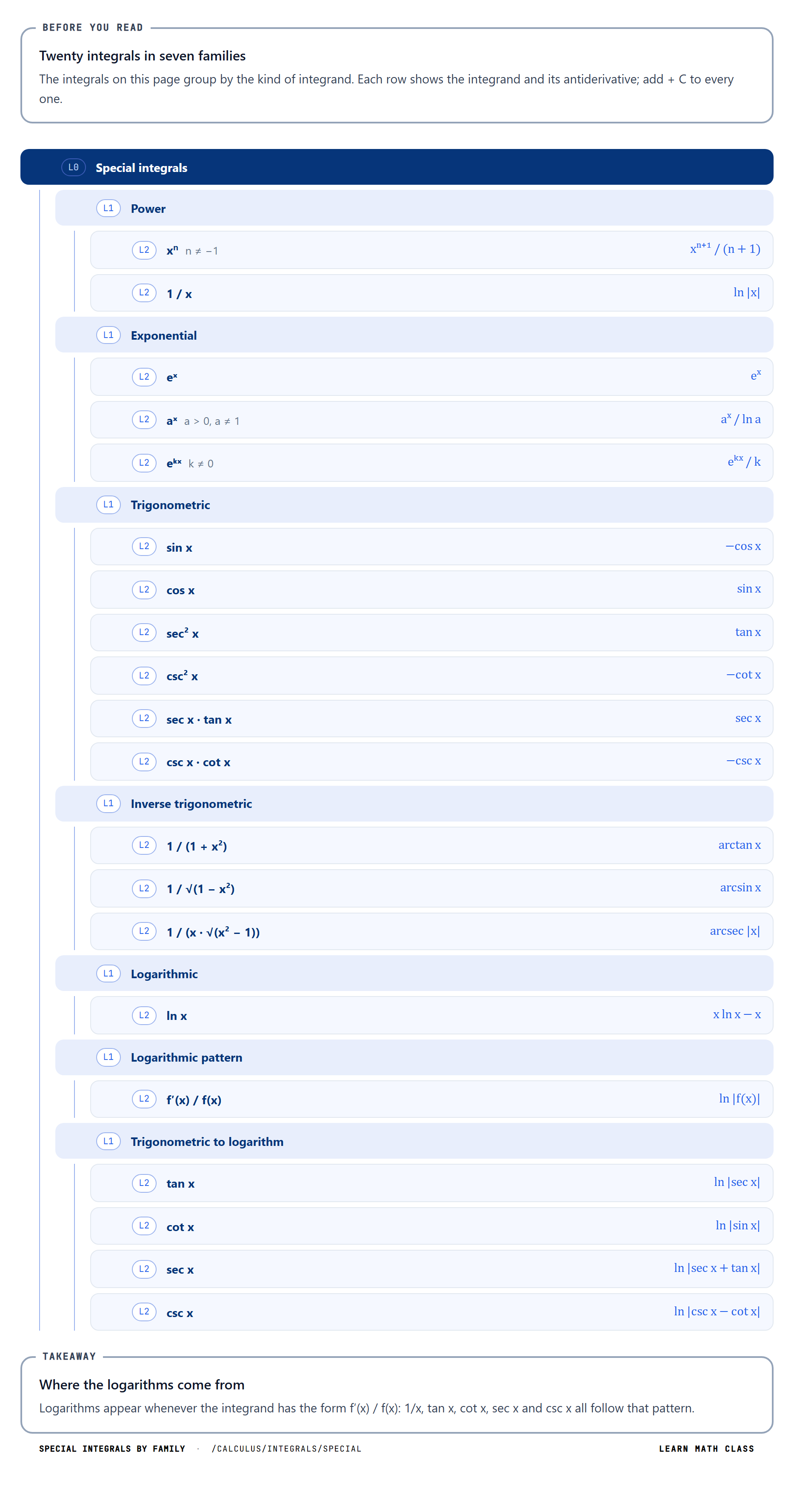
Each formula below reverses a known derivative. The integral of cosx\cos x is sinx\sin x because the derivative of sinx\sin x is cosx\cos x. The integral of 1/(1+x2)1/(1 + x^2) is arctanx\arctan x because the derivative of arctanx\arctan x is 1/(1+x2)1/(1 + x^2).

Memorizing these forms accelerates computation and provides reference points for more complex integrals. When a technique transforms an integral into one of these patterns, the work is essentially done.


Why Memorize Special Integrals?


    Integration techniques transform unfamiliar integrals into recognizable ones. These standard forms are the targets.

    Knowing them provides:


  • Each formula inverts a differentiation rule. Mastery of derivatives implies knowledge of these integrals.

Power Functions


The power rule for integration:

xndx=xn+1n+1+C(n1)\int x^n\, dx = \frac{x^{n+1}}{n+1} + C \qquad (n \neq -1)


The exponent increases by one; divide by the new exponent.

The exception n=1n = -1 is critical:

x1dx=1xdx=lnx+C\int x^{-1}\, dx = \int \frac{1}{x}\, dx = \ln|x| + C


The absolute value ensures validity for negative xx. For x>0x > 0, the antiderivative is lnx\ln x; for x<0x < 0, it is ln(x)\ln(-x). Both cases combine into lnx\ln|x|.

Exponential Functions


The exponential function is its own antiderivative:

exdx=ex+C\int e^x\, dx = e^x + C


For other bases:

axdx=axlna+C(a>0,a1)\int a^x\, dx = \frac{a^x}{\ln a} + C \qquad (a > 0,\, a \neq 1)


The factor 1/lna1/\ln a compensates for the chain rule in (ax)=axlna(a^x)' = a^x \ln a.

With a linear argument:

ekxdx=ekxk+C\int e^{kx}\, dx = \frac{e^{kx}}{k} + C


Trigonometric Functions


Basic trigonometric integrals:

sinxdx=cosx+C\int \sin x\, dx = -\cos x + C


cosxdx=sinx+C\int \cos x\, dx = \sin x + C


sec2xdx=tanx+C\int \sec^2 x\, dx = \tan x + C


csc2xdx=cotx+C\int \csc^2 x\, dx = -\cot x + C


secxtanxdx=secx+C\int \sec x \tan x\, dx = \sec x + C


cscxcotxdx=cscx+C\int \csc x \cot x\, dx = -\csc x + C


Each reverses a standard derivative. The negative signs in sinx\sin x and csc2x\csc^2 x integrals reflect the negatives in (cosx)=sinx(\cos x)' = -\sin x and (cotx)=csc2x(\cot x)' = -\csc^2 x.

Inverse Trigonometric Forms


These integrals produce inverse trigonometric functions:

11+x2dx=arctanx+C\int \frac{1}{1 + x^2}\, dx = \arctan x + C


11x2dx=arcsinx+C\int \frac{1}{\sqrt{1 - x^2}}\, dx = \arcsin x + C


1xx21dx=arcsecx+C\int \frac{1}{x\sqrt{x^2 - 1}}\, dx = \text{arcsec}\,|x| + C


More generally, with constant a>0a > 0:

1a2+x2dx=1aarctanxa+C\int \frac{1}{a^2 + x^2}\, dx = \frac{1}{a}\arctan\frac{x}{a} + C


1a2x2dx=arcsinxa+C\int \frac{1}{\sqrt{a^2 - x^2}}\, dx = \arcsin\frac{x}{a} + C


Logarithmic Integrals


The logarithm itself requires integration by parts:

lnxdx=xlnxx+C\int \ln x\, dx = x\ln x - x + C


A crucial pattern recognizes when integrands have the form f(x)/f(x)f'(x)/f(x):

f(x)f(x)dx=lnf(x)+C\int \frac{f'(x)}{f(x)}\, dx = \ln|f(x)| + C


This pattern appears frequently in disguise.

Example:

tanxdx=sinxcosxdx=lncosx+C\int \tan x\, dx = \int \frac{\sin x}{\cos x}\, dx = -\ln|\cos x| + C


Here f(x)=cosxf(x) = \cos x and f(x)=sinxf'(x) = -\sin x, so the integrand is f(x)/f(x)-f'(x)/f(x).

Integrals Leading to Logarithms


Several standard integrals produce logarithms:

tanxdx=lncosx+C=lnsecx+C\int \tan x\, dx = -\ln|\cos x| + C = \ln|\sec x| + C


cotxdx=lnsinx+C\int \cot x\, dx = \ln|\sin x| + C


secxdx=lnsecx+tanx+C\int \sec x\, dx = \ln|\sec x + \tan x| + C


cscxdx=lncscx+cotx+C=lncscxcotx+C\int \csc x\, dx = -\ln|\csc x + \cot x| + C = \ln|\csc x - \cot x| + C


The secx\sec x and cscx\csc x integrals are less obvious—they require multiplying by clever forms of 11 to create the f/ff'/f pattern.