As explained on the page about the probability of events, probability compares the outcomes we want to the full set of outcomes that could happen. The basic expression we already introduced there is:
Probability = (favourable outcomes) / (all possible outcomes)
Since "all possible outcomes" appears directly in the formula, it makes sense to understand what this collection actually is and how we identify it for different situations. That collection is the sample space. It describes every outcome the scenario can produce and forms the foundation for defining events and assigning probabilities.
The sample space is the complete collection of all possible outcomes a scenario can produce. Every outcome that can happen belongs to it, and anything that cannot happen is not included.
Each outcome represents one full, specific result of the situation. Together, these outcomes form the background on which events are defined and probabilities are assigned.
Examples: Rolling a die → {1, 2, 3, 4, 5, 6} Tossing two coins → {HH, HT, TH, TT} Measuring a persons height → all real numbers in an interval (for example, [0, 3] meters)
The sample space of two dice: 36 ordered outcomes
Every possible result of the two rolls appears exactly once: the row gives the first die, the column the second, and no cell is missing or repeated. The whole grid is the sample space and each event will be a group of its cells. Highlight groups and see them become events on the dice roll sample space explorer.
Sample spaces come in several types, listed next.
Sample Space Notation
Notation
Sample Space Notation
Two Greek letters carry the whole page — one capital for the set of everything that could happen, one lowercase for a single thing that did. The set-theory machinery they sit inside is borrowed wholesale, and every mark is catalogued among the probability symbols.
Capital omega names the set of every possible outcome of an experiment — the universe the whole problem lives inside, as Definition of Sample Space above establishes. Nothing outside Ω can occur, which is exactly why P(Ω)=1.
CasesIts shape varies with the experiment: a finite roster {1,2,3,4,5,6}, a countable list, or a continuous interval [0,∞) — Types of Sample Spaces below sorts them; multi-step experiments build it as a Cartesian product, Ω=A×B.
Also writtenS — the school-textbook letter, from "sample space"; older and applied texts also write U, borrowing the universal set that plays the same role in set theory.
Do not confuseAn event. Ω is the ground everything else is measured against, not one outcome competing for probability — it is the certain event, the only one whose probability is fixed in advance.
ω
little omega — a single outcome
Lowercase omega names one individual outcome, an element of the sample space: ω∈Ω. The case distinction does the work — capital for the whole collection, lowercase for one member, the same convention random variables use for X and x.
CasesOutcomes can be compound objects — an ordered pair (H,T) or a triple (x1,x2,x3) is still a single ω, which is what makes multi-step experiments fit the same framework.
Do not confuseAn event. ω is an element and A a subset, so membership and containment do not swap: ω∈Ω but A⊆Ω, and the singleton {ω} — not ω — is the event that outcome occurs. The element-versus-subset error arrives here in probability dress.
Same glyph elsewhereThe same letter is the primitive root of unity in complex numbers and angular frequency in physics — unrelated tenants of a much-used letter.
A⊆Ω
A is a subset of the sample space
Events are written as subsets: any collection of outcomes is an event, so the containment mark is how probability declares what it is about to measure — the bridge that lets set operations become event algebra.
CasesThe two extremes are named: Ω itself is the certain event and ∅ the impossible one; unions, intersections and complements of events are those set operations unchanged, which is what the events page exploits.
Do not confuseA statement about likelihood. The subset mark records structure only — which outcomes belong — while P(A) supplies the number; a large event is not automatically a probable one.
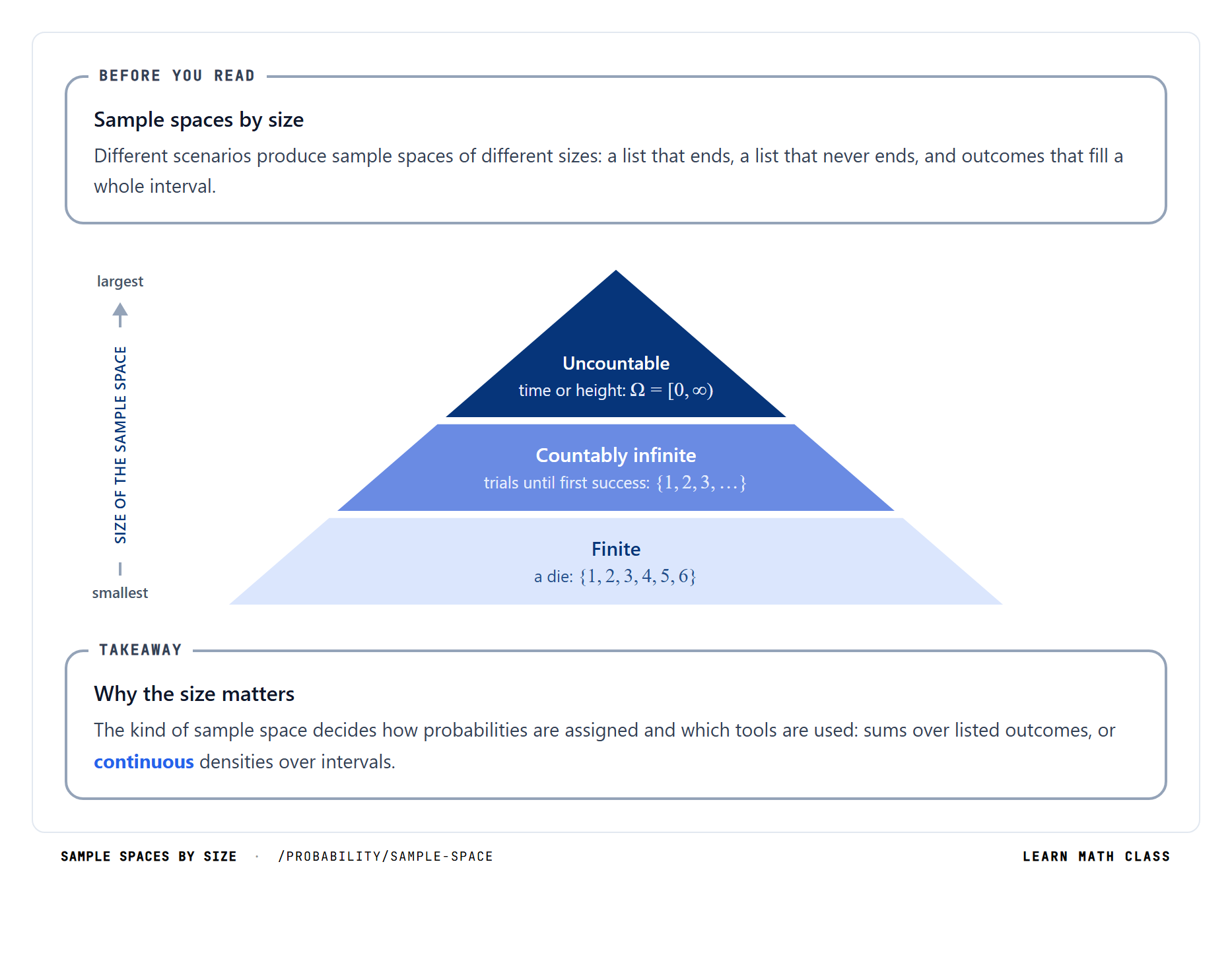
Different scenarios produce sample spaces of different sizes: a list that ends, a list that never ends, and outcomes that fill a whole interval.
largestsize of the sample spacesmallest
Uncountabletime or height: Ω=[0,∞)
Countably infinitetrials until first success: {1,2,3,…}
Finitea die: {1,2,3,4,5,6}
Takeaway
Why the size matters
The kind of sample space decides how probabilities are assigned and which tools are used: sums over listed outcomes, or continuous densities over intervals.
Once the sample space is identified, it can be written in different ways depending on the scenario and the size of the outcome set:
Explicit lists for small finite spaces, e.g. Ω={1,2,3,4,5,6}
Ordered pairs for multi-step experiments, e.g. two coin tosses Ω={(H,H),(H,T),(T,H),(T,T)}
Sequences or tuples when more than two components are involved, e.g. three dice Ω={(x1,x2,x3):xi∈{1,…,6}}
Intervals when outcomes vary continuously, e.g. a measurement Ω=[0,1]
Set-builder notation for describing outcomes by a rule, e.g. Ω={x:0≤x≤10}
Cartesian products for combining simpler spaces, e.g. Ω=A×B
These representations make it easier to see how outcomes are organized and how events will be formed from them.
Format
When to use
Example
Explicit list
small finite sample spaces
Ω = {1, 2, 3, 4, 5, 6}
Ordered pairs
two-step experiments where order matters
Ω = {(H, H), (H, T), (T, H), (T, T)}
Sequences / tuples
three or more components per outcome
Ω = {(x1, x2, x3) : xi ∈ {1, …, 6}}
Intervals
continuous outcomes on the real line
Ω = [0, 1]
Set-builder notation
outcomes defined by a rule or condition
Ω = {x : 0 ≤ x ≤ 10}
Cartesian product
combining two or more simpler sample spaces
Ω = A × B
Properties of a Sample Space
A sample space is not just any set—it must satisfy a few basic requirements so that probability can be defined consistently:
• It must include every outcome that can occur in the scenario. • It must exclude outcomes that cannot occur. • Its outcomes must be mutually exclusive (only one outcome happens in a single trial). • Its outcomes must be collectively exhaustive (something from the set must occur). • Events are formed by selecting subsets of the sample space: A⊆Ω.
These properties ensure that probabilities assigned to events make sense and behave consistently.
When the outcomes are equally likely, probability reduces to counting:
Events are built directly from the sample space. An event is simply a subset of Ω that collects the outcomes we care about in a particular question.
• If Ω describes everything that can happen, an event selects the outcomes where something specific happens. • For a die roll with Ω={1,2,3,4,5,6}, the event "roll an even number" is {2,4,6}. • For two coin tosses with Ω={(H,H),(H,T),(T,H),(T,T)}, the event "at least one head" is {(H,H),(H,T),(T,H)}. • For a continuous outcome like height, an event might be an interval such as [1.6,1.8].
Viewing events as subsets of Ω makes probability assignments consistent and ties every event back to the underlying structure of the scenario.
Even sum: an event as a subset of the sample space
The highlighted cells are an event, a subset of the grid picked out by a condition on the outcome. Half of the 36 cells satisfy it, so its probability is 18 over 36, and the complement is the unhighlighted half. Switch conditions and watch different subsets light up on the dice roll sample space explorer.
Practical examples show how the sample space shapes such subsets.
Sample Space in Practice
Different situations lead to different forms of sample spaces. A few common examples show how the idea appears in everyday probability questions:
• A die roll: Ω={1,2,3,4,5,6} • A deck draw: Ω= all 52 individual cards • Two coin tosses: Ω={(H,H),(H,T),(T,H),(T,T)} • Measuring a person's height: Ω=[0,3] • Time until an event occurs: Ω=[0,∞) • Choosing two items without replacement: outcomes are ordered pairs of objects
These examples show how the structure of Ω changes with the scenario, but the idea remains the same: it captures every outcome the situation can produce.
Three coin tosses: eight equally likely sequences
Repeating a two-outcome experiment three times gives a sample space of eight ordered sequences, each with probability 1/8. Listing them explicitly is the first step in every question about the experiment. Group the sequences by number of heads on the coin toss sample space explorer.
Common mistakes usually come from getting this list wrong.
Common Mistakes
• Leaving out outcomes that actually can occur in the scenario • Including outcomes that cannot occur • Ignoring the order of outcomes when order matters • Mixing outcomes of different types within the same sample space • Using an incomplete Ω, which leads to incorrect event definitions or wrong probabilities
A correct sample space removes ambiguity and prevents errors in later calculations.
Mistake
What is actually correct
Leaving out outcomes that can occur
Ω must include every outcome the scenario can produce
Including outcomes that cannot occur
Ω must exclude any outcome the scenario cannot produce
Ignoring order when order matters
distinguishable outcomes need distinct entries in Ω
Mixing outcomes of different types in one Ω
a single sample space should use one consistent kind of outcome
Using an incomplete Ω
events must reference the full Ω, not a truncated version
Ignoring order changes the probabilities
Two dice have 36 equally likely ordered outcomes. If the order is dropped, the result “one 1 and one 2” covers two of them, (1,2) and (2,1), while “double 1” covers only (1,1). The 21 unordered results are therefore not equally likely: P({1, 2}) = 2/36 but P({1, 1}) = 1/36. Treating them as 21 equal outcomes would give 1/21 to each and get both wrong.
Counting with ordered pairs keeps every outcome at 1/36, so probabilities can be found by counting cells.
Connections to Other Concepts
• Events are subsets of Ω, built directly from the sample space • Probability of events is defined only after Ω is fixed • Random variables map outcomes in Ω to numerical values • Joint sample spaces describe outcomes of several variables together • Independence and dependence are interpreted through how outcomes combine in Ω
The sample space anchors every other concept in probability, making it the natural starting point for the entire subject.
Sample Spaces at a Glance
The page has shown that the sample space takes many shapes depending on the scenario, and that events live as subsets of whichever Ω the situation defines. The table below collects representative scenarios in one place, pairing each with its sample space, a single outcome from it, and an example event constructed as a subset — making explicit the pattern that runs through every section of the page.
Scenario
Sample space Ω
Example outcome ω
Example event (subset of Ω)
Roll a fair die
{1, 2, 3, 4, 5, 6}
4
{2, 4, 6} — “even result”
Toss two coins
{HH, HT, TH, TT}
HT
{HH, HT, TH} — “at least one head”
Draw a card from a deck
52 individual cards
“Ace of Spades”
the 13 hearts — “draw a heart”
Trials until first success
{1, 2, 3, …}
4
{1, 2, 3} — “succeed within 3 trials”
Measure a person's height
[0, 3] meters
1.75
[1.6, 1.8] — “between 1.6 and 1.8 m”
Time until an event
[0, ∞)
t = 3.7
[0, 5] — “within 5 minutes”
Sample Space FAQ
What is the difference between an outcome and an event?
+
An outcome is a single element of the sample space, written ω ∈ Ω. An event is a subset, written A ⊆ Ω, and may contain many outcomes, one, or none. The distinction is element versus subset: the event that a particular outcome occurs is the singleton {ω}, not ω itself. Membership and containment do not swap.Read more →
Is (H, T) one outcome or two?
+
One. An outcome can be a compound object — an ordered pair, a triple, or any tuple — and it still counts as a single element of the sample space. For two coin tosses, Ω = {(H,H), (H,T), (T,H), (T,T)} has exactly four outcomes, not eight. Treating the components separately is what makes multi-step experiments look harder than they are.Read more →
Does order matter when listing a sample space?
+
It depends on the experiment, and getting it wrong is a standard error. For two coin tosses with distinguishable coins, (H,T) and (T,H) are different outcomes and Ω has four elements. If only the number of heads matters, the space is smaller. Decide what counts as one full result of the experiment, then list accordingly.Read more →
Does an event with more outcomes always have a higher probability?
+
Not in general. If one event is contained in another, A ⊆ B, then P(A) ≤ P(B) — that much always holds. But merely having more elements guarantees nothing, because outcomes need not be equally likely: a two-outcome event built from likely results can beat a ten-outcome event built from rare ones. The subset mark records structure; P supplies the number.Read more →
Why is the sample space written Ω instead of S?
+
Both are standard and name the same thing. Capital omega is the convention in measure-theoretic and university-level texts, while S — from the words sample space — is common in school textbooks. Older and applied writing sometimes uses U, borrowing the universal set from set theory. The letter carries no mathematical content, only house style.Read more →