In many situations, probabilities do not stay fixed. Once new information becomes available, how we assess a situation can change. Knowing that something has already happened often reshapes how we view what can happen next.
Conditional probability captures this shift in perspective. It reflects how uncertainty is evaluated after a condition is known, when attention is restricted to a smaller set of possibilities. This idea appears naturally whenever information arrives, observations are made, or situations unfold step by step.
The rest of the page explains how this change of viewpoint works, how it is expressed formally, and how it connects to other central ideas in probability.
When a condition is known, we no longer reason over all possible outcomes. The information tells us that only certain situations remain relevant, and everything outside that condition is discarded.
From this point on, probabilities are evaluated within the condition. We are not changing the event itself — we are changing the context in which it is viewed. The situation is the same, but the frame of reference is smaller.
This way of thinking explains why probabilities can change once information is known. Conditioning is not an extra rule added on top of probability; it is a shift in perspective caused by restricting attention to a specific part of what was originally possible.
Restricting to the condition
Learning that the two dice sum to 8 discards every other outcome (greyed out). Five equally likely outcomes remain: (2,6), (3,5), (4,4), (5,3), (6,2). Three of them have an even first die, so P(first die even | sum 8) = 3/5, although without the information the answer is 1/2. The event is the same; only the frame it is measured in has shrunk.
Dividing by P(sum 8) = 5/36 in the formula does exactly this rescaling to the 5 remaining cells.
Formal Meaning of Conditional Probability
Conditional probability describes how likely an event is once we know that another event has occurred. It represents a reassessment of uncertainty after information is taken into account.
The key idea is that the condition is treated as given. All reasoning is carried out under the assumption that this condition is true, and probabilities are evaluated relative to that restricted situation rather than the original one.
This verbal description captures the essence of conditional probability before any symbols or formulas are introduced.
Given A: only the subtree below A remains
Once A is known to have occurred, the lower branch is discarded and the two branches below A are the whole remaining world. Their weights, P(B given A) and its complement, already add to 1, which is exactly what a conditional probability is: the probabilities inside the restricted situation. Change P(B given A) and watch only that subtree respond on the conditional probability tree diagram.
The formula makes this restriction a division.
Conditional Probability Notation
Notation
Conditional Probability Notation
One vertical stroke changes everything it stands in: inside P(⋅) it means "given". The bar is not an operation and not a division — it marks which world the probability is being measured in. All the marks here are catalogued among the probability symbols.
The bar reads "given": everything to its right is assumed to have happened, and the probability of what stands to its left is measured inside that restricted world — Conditioning as Restricting the Situation above draws the picture. The bar belongs to the notation, not to the arithmetic.
CasesThe condition can be any event with P(B)>0; chained conditions stack on the same side, P(A∣B∩C), and the formula below turns the bar into a ratio — the division happens because of the definition, not because the bar divides.
Do not confuseP(B∣A). Swapping the sides reverses the statement completely — "probability of disease given a positive test" versus "probability of a positive test given disease" — the confusion Common Mistakes below singles out, and the reason Bayes' theorem exists.
The joint probability: the intersection names the event that both occur, so P(A∩B) measures the overlap — the numerator of the conditional formula, and the quantity the bar is silent about.
Also writtenP(A,B) — the comma form, standard once several variables are in play, and P(AB) by juxtaposition in older and applied texts; all three name the same overlap.
Do not confuseThe conditional. P(A∩B) measures inside the whole sample space while P(A∣B) measures inside B alone — the same numerator, different denominators, which is exactly what the formula makes explicit.
P(A∣B)=P(A)
conditioning on B changes nothing
Independence written as a non-event: knowing B leaves A's probability untouched. The equation is the notation — there is no dedicated symbol in elementary work, as Conditional Probability vs Independence below explains.
CasesThe multiplicative form P(A∩B)=P(A)P(B) says the same thing without a bar, and survives when P(B)=0 makes the conditional undefined; advanced texts abbreviate the relation as A⊥B, borrowing the perpendicularity mark.
Do not confuseDisjointness. Mutually exclusive events satisfy P(A∩B)=0, which makes them maximally dependent — knowing one occurred rules the other out; independence and exclusivity are near-opposites wearing similar-looking equations.
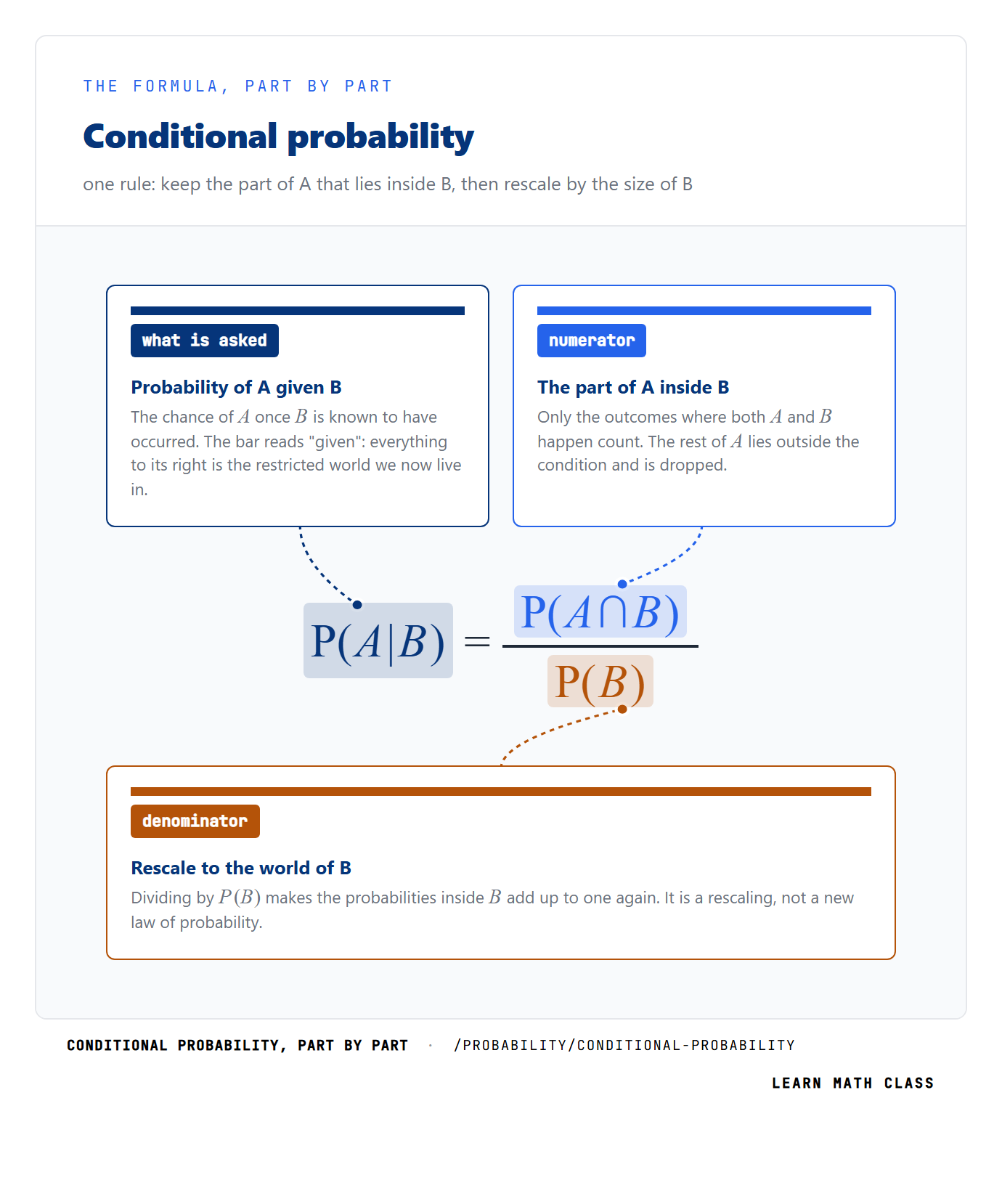
The idea of conditioning becomes precise through a simple normalization rule. When we restrict attention to situations where B has occurred, probabilities must be rescaled so that they sum to one within that restricted context.
The numerator represents the part of A that is compatible with the condition B. The denominator accounts for the fact that we are now working only inside B.
This formula does not introduce a new probability law — it expresses how probabilities behave once the situation has been restricted by known information.
The formula has three parts, and the lines above have named each of them: the conditional probability on the left, the joint probability P(A∩B) in the numerator, and the probability of the condition, P(B), in the denominator. Here they are taken apart and labelled.
The part most often misread is the bar. P(A∣B) and P(B∣A) share the same numerator but divide by different events, so they are different numbers; Bayes' theorem is the rule for converting one into the other.
Visual Representations
Conditional probability becomes clearer when viewed geometrically or sequentially.
Venn diagram view: The condition B restricts attention to a smaller region of the sample space. The probability of A is then evaluated only within that region, as the proportion of the overlap A∩B relative to B itself.
Tree diagram view: In a probability tree, conditioning corresponds to moving along a branch where a condition has already occurred. Probabilities along later branches are evaluated relative to that branch, not the entire tree.
These visual perspectives reinforce the idea that conditioning is a change of viewpoint, not a change in the underlying events.
Event A across three compartments, the middle one selected
Selecting a compartment restricts attention to it: the part of A inside the compartment stays solid while the rest of A fades, and the conditional probability is the solid share of the selected compartment. The Venn view and the tree view describe the same rescaling. Select another compartment and compare the shares on the partition Venn diagram.
Concrete examples make the same restriction numerical.
Examples
1. Information Changes the Probability Suppose A is "a randomly chosen person has a university degree" and B is "the person is over 40." The probability of A evaluated after knowing B may differ from the overall probability of A, because the condition changes the relevant group.
2. No Change Under Conditioning If A is "tomorrow is sunny" and B is "a fair coin lands heads today," knowing B has no effect on how we evaluate A. In this case, conditioning does not change the probability, illustrating a link to independence.
3. Sequential Situations Consider drawing two cards from a deck without replacement. Let A be "the second card is an ace" and B be "the first card is an ace." Knowing whether B occurred changes how we evaluate A, because the situation after the first draw is different from the original one.
These examples show how conditional probability reflects the impact of information on how uncertainty is assessed. The table below sets them side by side so the three distinct behaviors — change, no change, and sequential dependence — can be compared directly.
Setup (events A, B)
Effect of knowing B
Why
Behavior shown
A: has a degree; B: over 40
P(A|B) ≠ P(A)
condition selects a different group with different proportions
information changes the probability
A: tomorrow is sunny; B: coin lands heads today
P(A|B) = P(A)
the events are unrelated; knowing B reveals nothing about A
A: second card is an ace; B: first card is an ace (no replacement)
P(A|B) ≠ P(A)
after B, the deck composition has changed
sequential dependence
A 2 by 2 contingency table with row and column totals
Each example is a table: the row for A holds the joint counts with B and its complement, and the conditional probability P(A given B) is the A cell in the B column divided by the column total. Reading down a column instead of across the whole table is the restriction in tabular form. Edit the cells and watch the conditionals update on the contingency tables explorer.
Independence is the case where this restriction changes nothing.
Conditional Probability vs Independence
Conditioning usually changes probabilities, because new information restricts the situation we are considering. Once a condition is known, the frame of reference shifts, and probabilities are re-evaluated within that restricted context.
Independence is the special case where this shift does not occur. If events are independent, then knowing that one event happened provides no information about the other. In that case, conditioning leaves probabilities unchanged.
This contrast is crucial:
Conditional probability describes how probabilities update when information is known.
Independence describes when such an update is unnecessary.
Understanding this distinction prevents a common mistake — assuming probabilities should change just because a condition is mentioned, or assuming independence without justification.
A condition that changes nothing
Now the condition is that the first die is even, which keeps 18 outcomes, rows 2, 4 and 6. In every kept row exactly one cell has a 5 on the second die, so P(second die 5 | first even) = 3/18 = 1/6, the same as with no condition. The first die carries no information about the second: the two events are independent.
Compare the sum-8 condition above, which moved the probability from 1/2 to 3/5.
Common Patterns Where Conditioning Appears
Conditional probability shows up naturally in many recurring situations.
One common pattern is "given that…" reasoning, where information is stated explicitly and probabilities must be evaluated under that condition. Another is filtering, where attention is restricted to cases that meet a certain criterion before any assessment is made.
Conditioning also appears in sequential processes, where earlier outcomes affect how later ones are viewed, and in classification problems, where probabilities are evaluated within specific groups or categories.
Recognizing these patterns helps identify when conditional probability is required, even if the word "given" is not explicitly used. The table below lays out each pattern with the linguistic or structural signal that tends to flag it, what gets restricted, and a sample phrase that triggers it.
Pattern
Recognition signal
What gets restricted
Example trigger
"Given that" reasoning
explicit words: "given", "knowing", "assuming"
reasoning takes place inside the stated condition
"given that the test is positive…"
Filtering
a subgroup is selected before any assessment
attention to cases meeting a criterion
"among students who passed…"
Sequential processes
step-by-step where earlier outcomes affect later ones
the state after step k affects step k+1
second card drawn after the first is removed
Classification
probabilities evaluated within a group or category
the group of interest is the new sample space
"among customers in segment X…"
Common Mistakes
Conditional probability is often misapplied, even in simple situations.
A frequent mistake is forgetting to restrict the situation properly and continuing to reason as if all outcomes were still possible. Another common error is dividing by the wrong probability, which leads to incorrect normalization.
Confusing P(A∣B) with P(B∣A) is especially widespread and can completely reverse the meaning of a statement. It is also common to assume independence implicitly, treating conditioning as irrelevant without justification.
Being explicit about what is known and what space is being considered helps avoid these errors. The table below names each pitfall, the specific way reasoning breaks down, and the corrective habit that prevents it.
Mistake
What goes wrong
Correct approach
Not restricting the situation
reasoning continues as if all original outcomes were still possible
recompute everything inside B; outcomes outside B are discarded
Dividing by the wrong probability
numerator is right but denominator uses P(A) or some other quantity
denominator is always P(B), the probability of the condition
Confusing P(A|B) with P(B|A)
the statement is reversed and its meaning changes entirely
identify which event sits after the bar (the condition) vs before it (the target)
conditioning is treated as irrelevant without checking
verify P(A|B) = P(A) before treating events as independent
Overview of Conditional Probability
The sections above develop conditional probability piece by piece: as a shift in frame of reference, a normalization formula, a contrast with independence, and a set of recognizable patterns and pitfalls. The table below collects these threads into a single reference card — naming each essential aspect of conditioning and the key point to keep in mind when applying it.
Aspect
What it captures
Key point
Meaning
reassessment of uncertainty when a condition is known
which event is the condition matters for the meaning
Why Conditional Probability Matters
Conditional probability is the mechanism by which probability responds to information. It models learning, observation, and the updating of beliefs as new facts become known.
This idea lies at the heart of inference, decision-making, and prediction. It underpins statistical reasoning, risk assessment, and data analysis, where conclusions must be drawn in the presence of partial information.
Without conditional probability, probability theory would be unable to describe how uncertainty evolves when knowledge changes.
Connections to Other Probability Concepts
Conditional probability connects directly to many central ideas in probability.
Understanding conditional probability clarifies how these concepts fit together into a single coherent framework.
Conditional Probability FAQ
Is P(A|B) the same as P(B|A)?
+
No, and swapping them reverses the claim entirely. The probability of having a disease given a positive test and the probability of a positive test given the disease are different numbers, often wildly so. The first depends on how common the disease is; the second does not. Converting between them is what Bayes' theorem is for.Read more →
Does the vertical bar in P(A|B) mean division?
+
No. The bar reads “given” and marks which world the probability is measured in — everything to its right is assumed to have happened. Division does appear in the formula P(A|B) = P(A ∩ B)/P(B), but that comes from the definition, not from the bar. The same stroke means “such that”, “divides”, and absolute value elsewhere.Read more →
What is the difference between P(A and B) and P(A given B)?
+
The denominator. P(A ∩ B) measures the overlap against the whole sample space; P(A|B) measures that same overlap against B alone. They share a numerator and differ only in what counts as everything. That is why P(A|B) = P(A ∩ B)/P(B) — dividing by P(B) rescales the overlap so that B becomes the new total.Read more →
What happens if the conditioning event has probability zero?
+
P(A|B) is undefined. The formula divides by P(B), so the condition must satisfy P(B) > 0 — you cannot restrict attention to a world that never occurs. The multiplicative form P(A ∩ B) = P(A)P(B) survives in that case, which is one reason independence is often stated that way rather than with a bar.Read more →
How do you condition on more than one event?
+
Stack the conditions on the right of the bar, joined by intersection: P(A | B ∩ C) is the probability of A once both B and C are assumed to have happened. The restricted world simply shrinks further. Everything on the right is treated as known; only what stands to the left is being measured.Read more →