Probability Axioms
The Rules That Make Probability Possible
Probability is not just intuition or guesswork. Behind every probability statement lies a small set of rules that determine what is allowed and what is not. These rules do not tell us how likely something is — they define what it even means for a probability assignment to make sense.
The probability axioms describe the basic constraints any valid probability model must obey. They act as the foundation beneath all probability reasoning, ensuring consistency across different situations, interpretations, and applications.
Everything that follows in probability — conditional probability, independence, total probability, Bayes' reasoning, random variables — ultimately rests on these rules. This page introduces the role of the axioms and explains why they are essential before any further structure is built.
Key Terms
Probability— a number in assigned to each event
Probability Measure— the function satisfying non-negativity, normalization, and additivity
Relative Frequency— proportion of times an event occurs in trials
Sample Space— the set with
Event— a subset to which assigns a value
Null Set— , with
What Are Axioms and Why Do We Need Them in Probability
Axioms are the foundation of any mathematical theory. They are the basic rules, the cornerstones, the starting assumptions that we accept without proof. Every branch of mathematics — geometry, algebra, calculus, and probability — is built on axioms. They are the bedrock statements from which everything else follows through logical reasoning.
In geometry, we start with axioms like "a straight line can be drawn between any two points." In algebra, we have axioms about how addition and multiplication behave. These are not proven — they are assumed to be true, and from them we derive theorems, corollaries, and all the rules that make the field work. Axioms are milestones that anchor the entire structure. They provide the foundation from which we build, through logical inference, all the knowledge in that field. Without axioms, there would be no starting point, no common ground, and no way to ensure that our reasoning leads to consistent conclusions.
Axioms in mathematics are the foundational cornerstones upon which entire theories are built. They:
• Provide foundation without requiring proof
• Serve as starting points for logical reasoning
• Generate theorems and corollaries through deduction
• Ensure internal consistency
• Define the boundaries of what's valid in the theory
• Create common ground for all work in that field
• Enable construction of the entire mathematical structure
• Prevent contradictions
Axioms, essentially, are the foundation to any further mathematical reasoning: theorems, corollaries, inference,proofs.
In this sense, every mathematical field requires axioms as a foundation for further development. Probability is no different. Like any other field of mathematics, probability needs its own cornerstones to base the entire process of logical inference upon. Without axioms, probability would be nothing more than intuition and guesswork — different people reasoning in different ways with no guarantee of consistency. The axioms establish the foundation. From these basic assumptions, all the theorems, formulas, and techniques of probability theory emerge through logical deduction.
The probability axioms are not arbitrary. They reflect fundamental properties we expect probability to have: that it cannot be negative, that certainty corresponds to a fixed value, and that probabilities combine in predictable ways when situations are mutually exclusive. These simple rules, accepted without proof, are enough to generate the entire structure of probability theory. Everything that follows — conditional probability, independence, expected values, distributions — traces back to these foundation stones.
The Probability Axioms (Overview)
The foundations of probability are given by a small set of rules that every valid probability assignment must satisfy. These are known as the probability axioms. Each axiom expresses a basic constraint that reflects how probability is expected to behave.
Non-negativity
Probabilities cannot be negative. Every event is assigned a value that is zero or greater.
Normalization
The event that represents "something happens" — the entire sample space — is assigned probability one. This fixes the scale of probability.
Additivity for Disjoint Events
When two events cannot occur together, the probability that one or the other occurs is the sum of their probabilities. Disjoint situations contribute independently to the total.
Together, these axioms define what it means for a probability assignment to be valid. All further probability rules are consequences of these basic constraints. The table below collects them in compact form — the formal statement, in standard probability notation, and the meaning behind each.
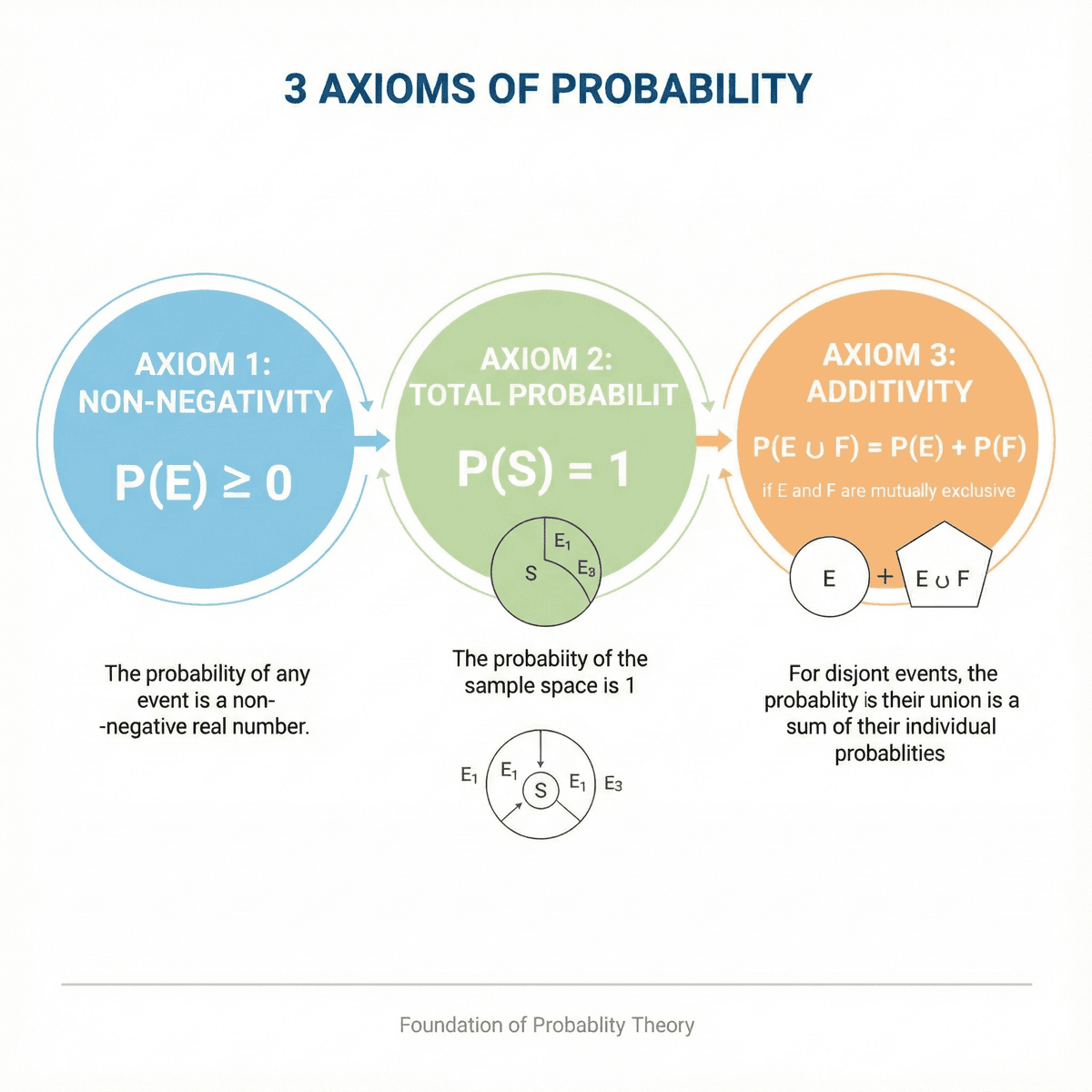
Axiom 1 — Non-Negativity
Probability is meant to measure plausibility. At the most basic level, this measure cannot be negative. An event may be impossible, unlikely, or very likely, but it cannot have a "negative chance" of occurring.
This axiom states that every event is assigned a probability that is zero or greater. It rules out assignments that would contradict the interpretation of probability as a measure of possibility.
In symbolic form, the axiom is written as:
Non-negativity is a structural constraint, not a computational rule. Any assignment that violates it cannot represent a valid probability model, regardless of how the probabilities were obtained.
These two axioms (non-negativity and normalization) are fundamental for both Probability Mass Functions (PMF) in the discrete case and Probability Density Functions (PDF) in the continuous case.
Axiom 2 — Normalization
Probability is measured on a fixed scale. The event that represents absolute certainty — that something happens — must anchor this scale.
This axiom states that the probability of the entire sample space is equal to one. It establishes what "100% certainty" means and ensures that all other probabilities are measured relative to this reference point.
In symbolic form, the axiom is written as:
Normalization does not describe a particular event. It fixes the scale of probability itself. Without it, probability values would have no consistent meaning across different models.
These two axioms (non-negativity and normalization) are fundamental for both Probability Mass Functions (PMF) in the discrete case and Probability Density Functions (PDF) in the continuous case.
Axiom 3 — Additivity for Disjoint Events
When two events cannot occur together, their probabilities should contribute independently to the total chance that one of them occurs. Disjoint situations do not interfere with one another, so there is no overlap to account for.
This axiom states that if events share no common outcomes, the probability that one or the other occurs is the sum of their probabilities. It formalizes how probability combines across mutually exclusive cases.
In symbolic form, the axiom is written as:
whenever
Additivity captures the idea that probability accumulates across exclusive alternatives. It is the mechanism that allows probability to be built up from separate cases into a complete description of uncertainty.
Immediate Consequences of the Axioms
- Probability of the empty event
The event that cannot occur has probability zero. - Probability of complements
For any event, the probability of its complement is determined by how much probability remains once the event itself is accounted for. - Monotonicity
If one event is contained within another, its probability cannot be larger. - Additivity for two events
For any two events, the probability of their union can be expressed by combining their individual probabilities while correcting for any overlap.
Once the axioms are in place, several basic results follow automatically. These are not additional assumptions — they are direct consequences of the three axioms.
These results show how much structure is already enforced by the axioms alone. Many familiar probability rules emerge without introducing any new principles. The table below names each consequence with its formal statement and the line of reasoning that produces it from the axioms.
What the Axioms Do Not Assume
- No independence assumption
The axioms do not state that events are independent. Independence is an additional property that must be justified separately. - No equal-likelihood assumption
Nothing in the axioms says outcomes or events are equally likely. Uniform probability is a modeling choice, not a requirement. - No symmetry or fairness
The axioms do not assume coins are fair, dice are balanced, or processes are symmetric. - No restriction to finite spaces
The axioms apply equally to finite, countable, and continuous sample spaces.
The probability axioms are intentionally minimal. They impose consistency, but they do not encode any specific modeling choices. Several common assumptions are not built into the axioms.
This section is crucial because it separates what probability requires from what is often assumed. Many misunderstandings arise from attributing extra meaning to the axioms that they do not contain. The table below collects each non-assumption alongside what it means and where the corresponding assumption must come from if a model needs it.
Why the Axioms Matter in Practice
The axioms ensure that probability models behave consistently, no matter where they are applied. They prevent contradictory assignments and make it possible to reason reliably about uncertainty across different contexts.
Because the axioms are universal, probability models built in one domain can be transferred to another without changing their logical foundation. This is why the same probability rules apply in science, engineering, data analysis, and decision-making.
In practice, the axioms act as a safeguard. Any model that violates them may produce numbers, but those numbers cannot be interpreted coherently as probabilities.
Connections to Other Probability Concepts
- Events are the objects to which probabilities are assigned.
- Sample spaces define the universe in which those events live.
- Conditional probability arises by applying the axioms under restricted information.
- Total probability follows from additivity across cases.
- Independence describes special situations where conditioning has no effect.
- Random variables and probability distributions extend the axioms to numerical outcomes.
The probability axioms form the base layer of the entire probability framework.
Every probability concept ultimately traces back to these axioms, making them the unifying foundation of the subject.
How the Axioms Generate Probability Theory
The three probability axioms are minimal in form, yet through logical inference they generate the entire structure of probability — conditional probability, total probability, independence, Bayes' theorem, random variables, and distributions all trace back to them. The table below collects the key downstream concepts, naming what each builds on and what the axioms ultimately provide.
Probability Axioms FAQ
Does probability zero mean an event is impossible?
+
Not necessarily. The axioms give one direction: an event that cannot occur has probability zero. The reverse does not follow. On a continuous sample space every individual outcome has probability zero, yet one of them happens on every trial — drawing exactly 0.5 from [0,1] is possible but has probability zero. Impossible implies zero; zero does not imply impossible.Read more →
Why is probability measured from 0 to 1?
+
Because Axiom 2 fixes the top of the scale by declaring P(Ω) = 1, and Axiom 1 fixes the bottom by forbidding negative values. The choice of 1 is a convention, not a discovery — it makes probabilities comparable across different models and lets them read directly as proportions. Percentages are the same scale multiplied by 100.Read more →
Do the probability axioms assume a coin is fair?
+
No. The axioms say nothing about fairness, symmetry, or equal likelihood. They require only that probabilities be non-negative, that the whole sample space gets 1, and that disjoint events add. A loaded die and a fair die both satisfy all three. Assuming a coin is fair is a modeling choice you make and must justify separately.Read more →
Do the probability axioms work for continuous sample spaces?
+
Yes. Nothing in the three axioms restricts the sample space to a finite list; they apply unchanged to finite, countably infinite, and continuous spaces. What changes is the machinery used to assign the numbers — sums for discrete spaces, integrals of a density for continuous ones — but the constraints are identical in every case.Read more →
Are the complement and monotonicity rules extra axioms?
+
No — they are consequences, proved from the three axioms rather than assumed alongside them. The same goes for the impossible event having probability zero and for the two-event union rule that corrects for overlap. Only non-negativity, normalization, and additivity for disjoint events are taken as given; everything else is derived.Read more →