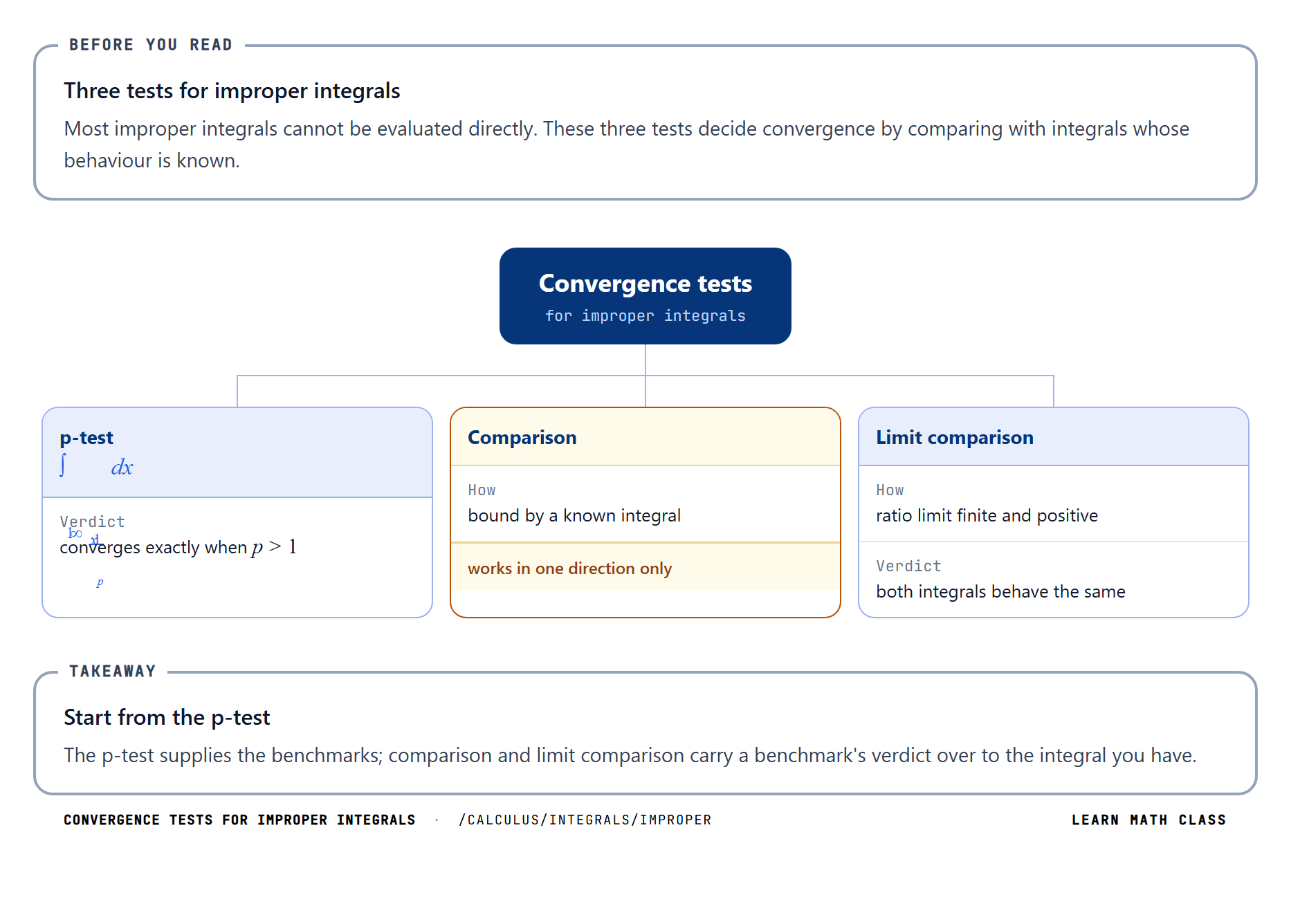
Determining whether an improper integral converges or diverges typically uses one of a small set of standard tests. The table below collects them in one place, pairing each test with the kind of integrand it suits, the conclusion it produces, and a worked benchmark from the sections above. Read the "When to use" column first when scanning an unfamiliar integral; the right row points directly to the test that settles convergence.
| Test |
When to use |
Conclusion |
Example or benchmark |
| Direct evaluation |
an antiderivative is available |
exact value if the limit is finite; otherwise diverges |
∫1∞ 1/x² dx = 1 |
| p-test at ∞ |
integrand behaves like 1/xp as x → ∞ |
converges iff p > 1 |
∫1∞ 1/xp dx (benchmark) |
| p-test near 0 |
integrand behaves like 1/xp as x → 0⁺ |
converges iff p < 1 |
∫01 1/√x dx (p = 1/2) |
| Direct comparison |
f ≥ 0 and bounded above by convergent g, or below by divergent g |
f inherits the convergence behavior of the comparator |
1/(x² + 1) < 1/x² ⇒ ∫ 1/(x² + 1) converges |
| Limit comparison |
f, g > 0 and limx → ∞ f/g = L with 0 < L < ∞ |
∫ f and ∫ g both converge or both diverge |
x/(x³ + 5) ~ 1/x² ⇒ ∫ x/(x³ + 5) converges |
Before you readThree tests for improper integrals
Most improper integrals cannot be evaluated directly. These three tests decide convergence by comparing with integrals whose behaviour is known.
TakeawayStart from the p-test
The p-test supplies the benchmarks; comparison and limit comparison carry a benchmark's verdict over to the integral you have.